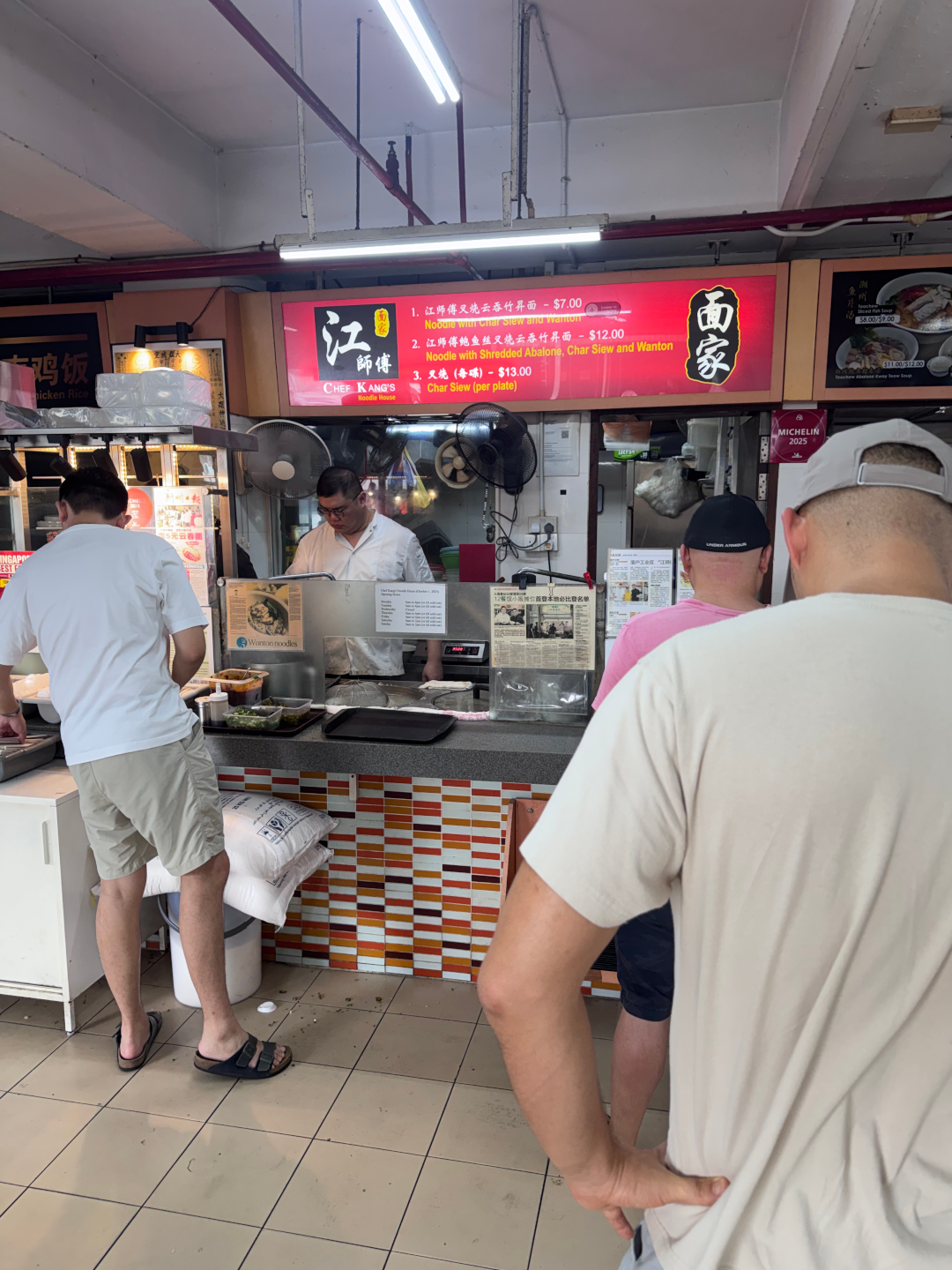
Wanton mee is one of those dishes every Singaporean has an opinion on. Thin noodles or springy? Black sauce or white? Char siew lean or fatty? Everyone has their go-to stall, and everyone thinks theirs is the best.
Chef Kang’s Noodle House at Jackson Square in Toa Payoh comes with more pedigree than most. It was started by Chef Ang Song Kang, whose Chef Kang’s restaurant on Mackenzie Road held a Michelin star from 2017 until it closed in October 2024, when he retired. The noodle house carried on, run by two of his protégés, brothers Moo Yun Kheng and Moo Yun Wah, and it’s still on the Michelin Bib Gourmand list, most recently in 2026. Big name, big expectations. So we headed down on a Saturday afternoon to find out whether Chef Kang wanton mee lives up to it. This Chef Kang’s Noodle House review is my answer.
Short answer: yes. Long answer below.
The Queue (Or Lack Of It)
Expect a long queue during peak hours. This is a Michelin-recognised stall in a neighbourhood that loves its food, after all. I’ve been here at peak before, and the wait is real.
We got there a little after 2pm on a Saturday, and there was plenty of parking and almost no queue. Just three or four people ahead of me. Damn!
One thing to note, though: the stall closes at 3pm on weekends (or earlier if they sell out), so 2-plus is cutting it a bit close. Go too late and you might find the shutters down.
The Michelin Wall
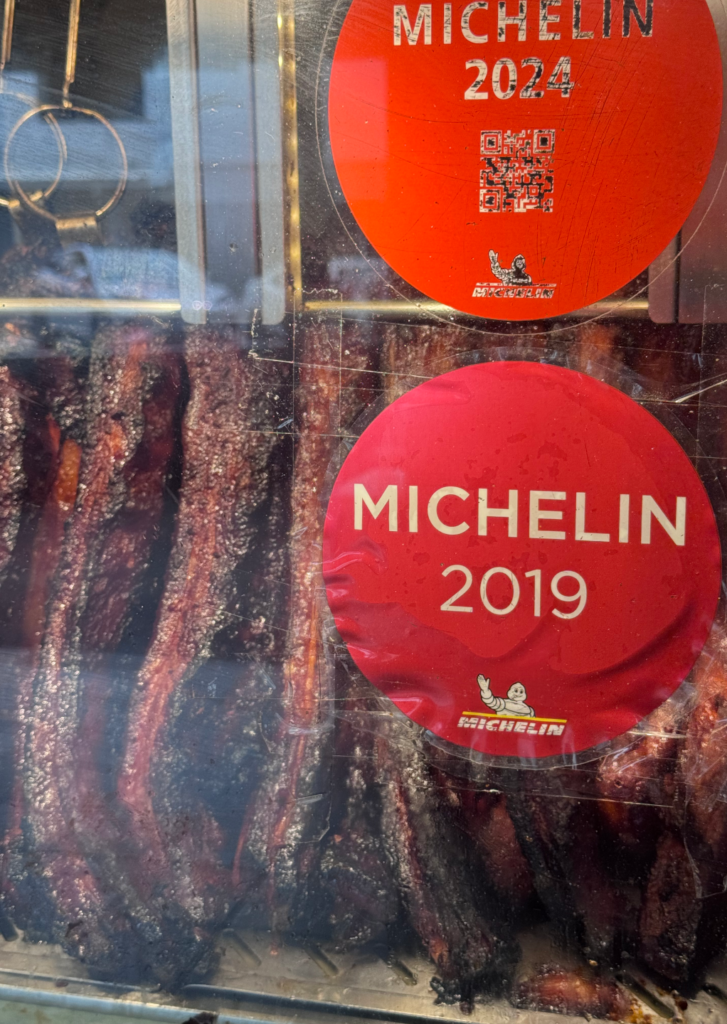
You can’t miss the hardware. There are Michelin 2019 and 2024 stickers plastered on the glass in front of the hanging char siew, and a Michelin 2025 plaque on the stall front. Pinned to the counter are newspaper clippings too, including one from the year the stall first made the Bib Gourmand list, and an old 新明日报 headline about its S$5 wanton mee.
Here’s the stall’s Bib Gourmand track record, for the curious:
- 2019: First listed, barely a year after opening in late 2018
- 2020: No Singapore guide that year (pandemic)
- 2021: Listed again
- 2022 and 2023: Dropped off the list
- 2024: Back on, as one of the new entries
- 2025 and 2026: Retained
That’s five Bib Gourmand years in total, and three in a row since its comeback. Not bad for a stall that outlived the Michelin-starred restaurant it was named after.
S$5. Those were the days. More on prices below.
What I Ordered
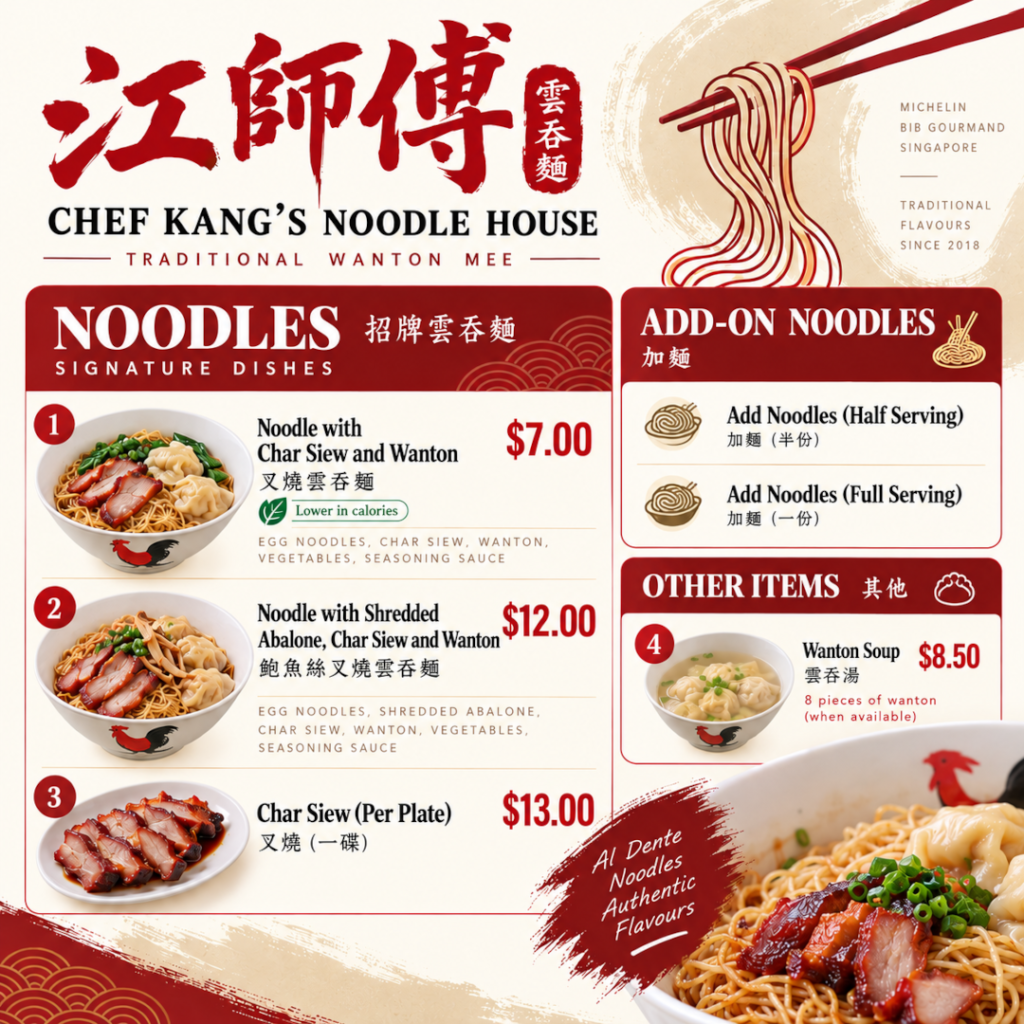
Prices at the time of my visit (October 2026).
The menu is short and sweet:
- Noodle with Char Siew and Wanton: S$7.00 (it even carries a “Lower in calories” label)
- Noodle with Shredded Abalone, Char Siew and Wanton: S$12.00
- Char Siew (per plate): S$13.00
If the S$7 bowl isn’t enough, you can add more noodles to it, either a half serving or a full serving. Of course, the extra noodles aren’t free. They come at an additional cost.
There’s also a wanton-only soup at S$8.50, which gets you eight wantons.
Heads up, though: the wanton soup isn’t always available. On a previous visit, they were short on wantons, and chef chose to keep them for the wanton noodles instead. Fair enough. Priorities.
So the S$5 bowl from the newspaper clipping is now S$7. Still a fair price for a Michelin-recognised bowl, if you ask me.
Chef Kang’s Noodle House Review: The Taste
Mix It Well
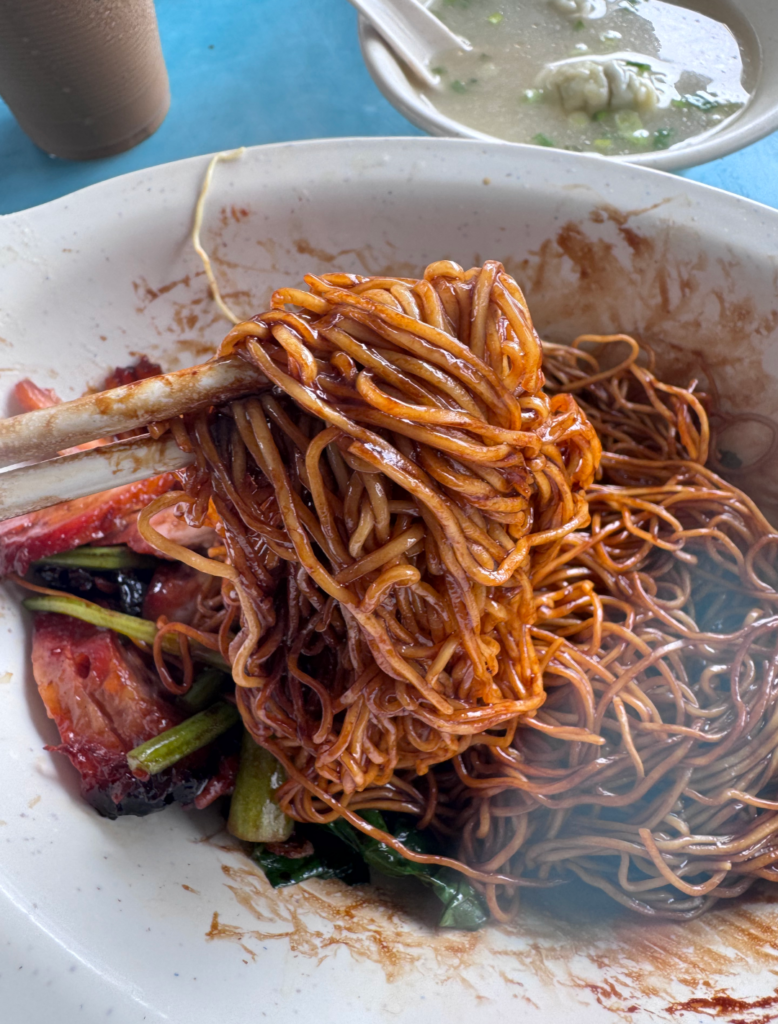
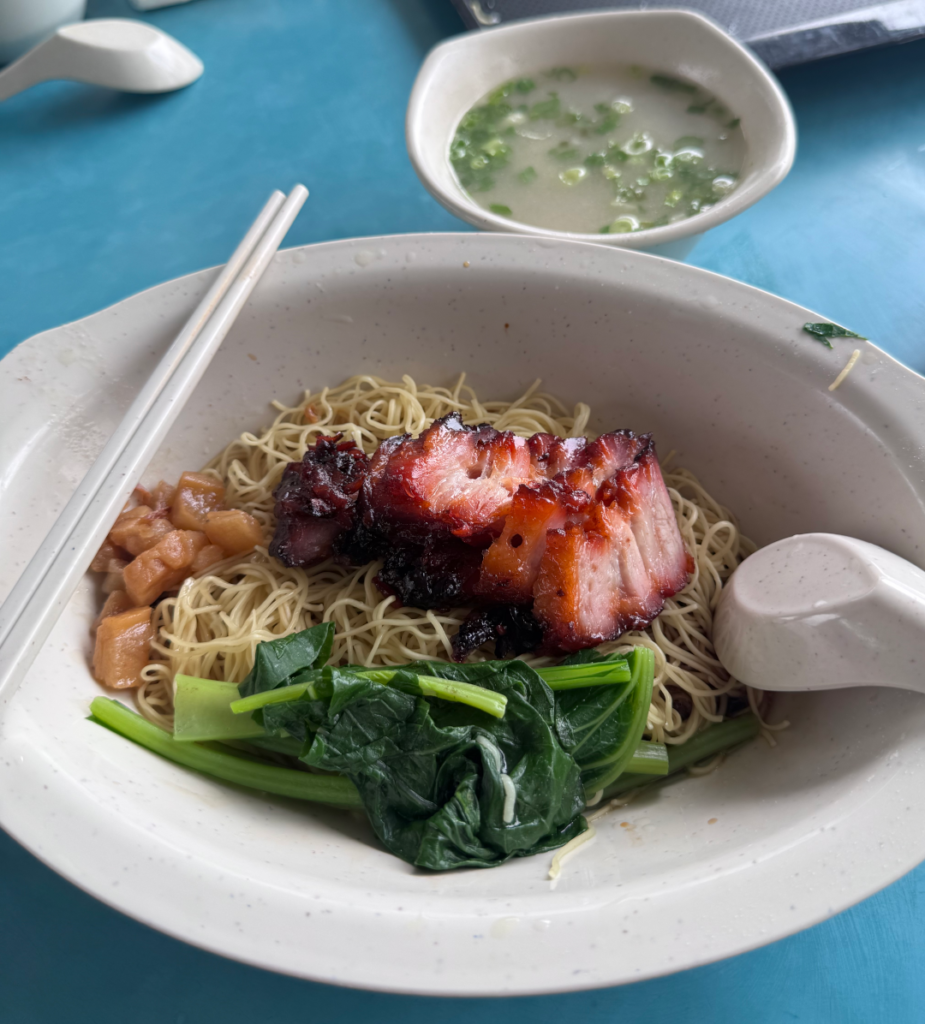
First things first: mix your noodles well. Really well. Done properly, every single bite was coated in oil and sauce. Yummy!
The noodles were cooked al dente, with a proper bite to them. These are jook sing noodles (the 竹升面 on the signboard), which according to the Michelin Guide are imported from Hong Kong and made with eggs, flour and a little alkaline water. You can tell this isn’t your average mee kia. You can watch chef blanch each portion right at the counter, chopsticks in one hand and strainer in the other. <!– VIDEO: Chef blanching noodles at the counter (IMG_7644) –>
The Chilli: Don’t Skip It
Here’s the thing that surprised me. The noodles come without chilli paste. You add your own from the condiment station at the counter.
Please add it. The house-made chilli paste is shrimp-based, and it brings plenty of shrimpy fragrance to the noodles. It elevates the entire dish. My only wish? It could be spicier. Fragrance it has in spades; the heat is more polite than punchy.
Once the chilli is mixed in, the bowl is packed with umami, and there are multiple dimensions in every mouthful:
- Fragrance and slipperiness from the oil
- Fragrance from the shrimp-based chilli paste
- Sweetness from the black sauce, a naturally fermented black soya sauce according to the Michelin Guide
Each one would be fine on its own. Together, they’re what makes this bowl special.
The Char Siew
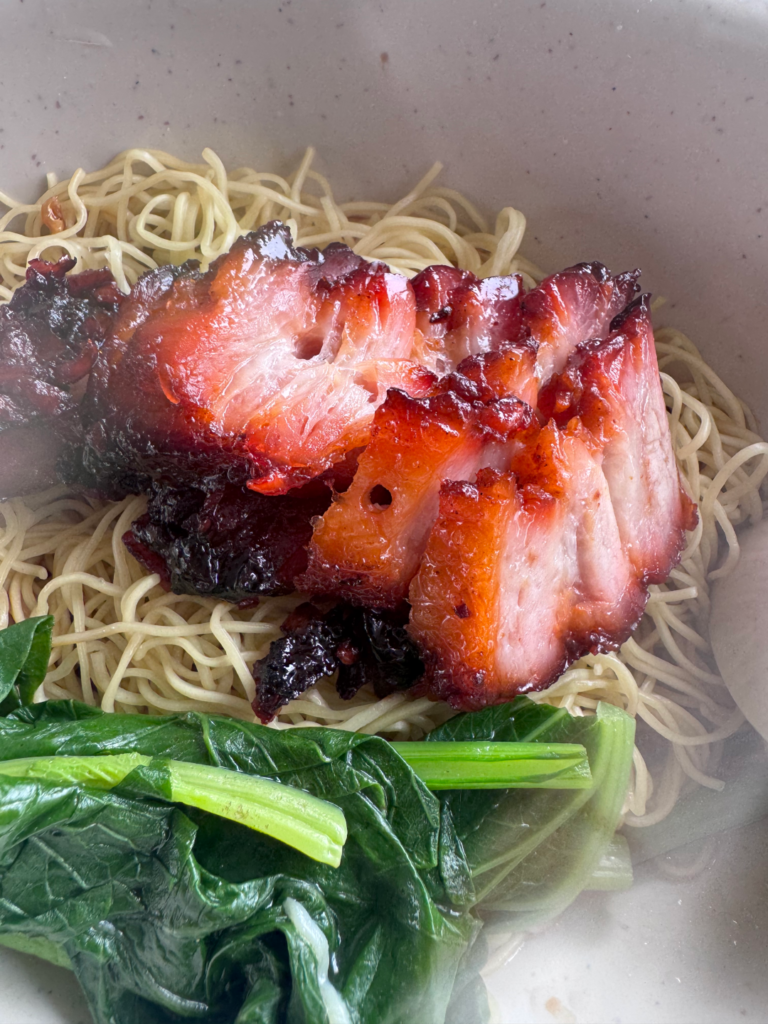
The char siew was half lean, half fat: objectively, the perfect balance. Enough fat to keep it juicy and tender, enough lean that you don’t feel like you’re eating pure lard. Personally, though, I like mine a bit fattier. That’s on me, not on chef. And the char. Look at the hanging slabs behind the glass and you’ll see a nicely charred, caramelised edge. Charred, not burnt. Just enough to give it that smoky bite without tipping into bitter. This is char siew that’s actually, well, char(red) siew. According to the Michelin Guide, the char siew is marinated overnight and roasted daily in a charcoal oven at the stall.
A fun side note: my wife spotted cartons of Lee Kum Kee char siu sauce and Lee Kum Kee oyster sauce at the stall. Is that what goes into the marinade? Who knows. Could be, could be for something else entirely. Either way, whatever they do with it works.
The Pork Lard
Speaking of lard, the pork lard here was really good. It’s the crunchy-with-substance kind, not the crunchy-and-airy kind that disappears the moment you bite into it. These bits have some body to them.
The Wantons
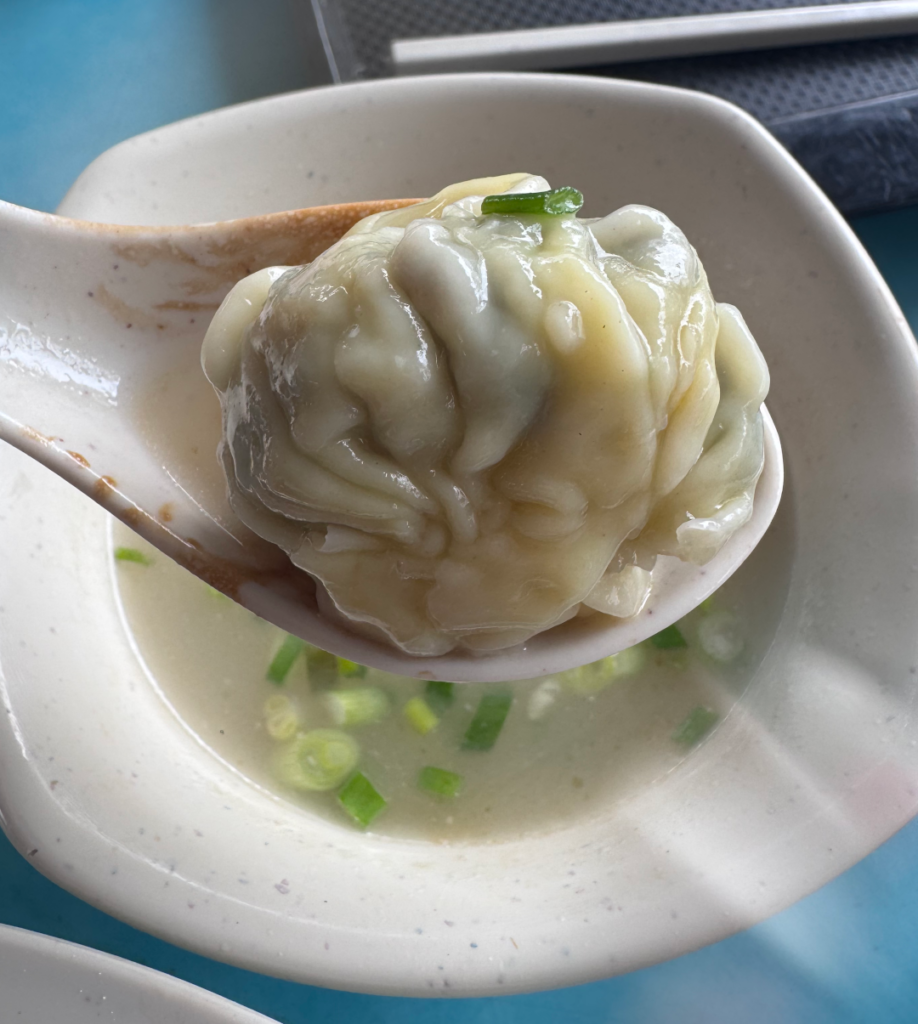
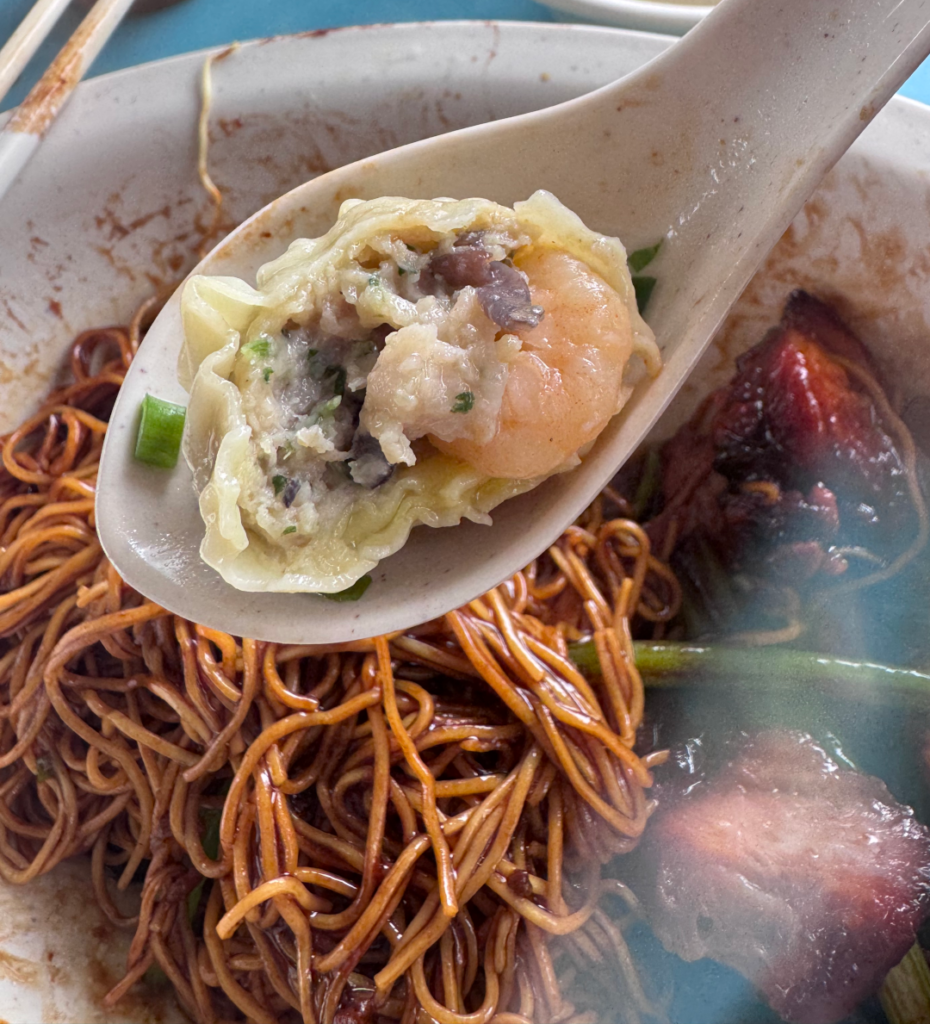
The wantons were big and filled with good ingredients. No sad little wrappers with a pea-sized dot of meat inside here. You can see them piled up in bowls next to the cooker, plump and ready to go.
The catch: you only get two in the S$7 noodle bowl. For the price, I’d like to see more. But given the quality of each one, I can let it slide. If you’re a wanton fiend, the S$8.50 wanton soup with eight of them is your friend, when it’s available.
The Soup
The soup was homey, the kind that tastes like someone’s mum made it. My first guess was ikan bilis, but I was wrong. According to the Michelin Guide, it’s a chicken broth made from at least 10kg of old chicken and 3kg of chicken feet, boiled for four to five hours. That explains the milky body. It’s a good companion to the rich noodles, though I wouldn’t call it the greatest. It does its job without stealing the show.
Pro Tips for Your Bowl
A few things I picked up that made my bowl even better:
- Add two spoonfuls of soup to your noodles. It gives them a heavenly, slippery texture in your mouth.
- Load up on spring onions in your soup. They’re free-flow at the condiment station. Extra fragrance, and more vegetables. Win-win.
- When it starts to get a bit jelak, add some green chilli. It’s right next to the spring onions. It cuts through the richness and resets your palate.
The Service: Thumbs Up to Chef
Now, you don’t go to a hawker stall expecting fine dining service. But the service here was impeccable to me. Chef was friendly and smiling throughout.
What really stood out was the customer in front of me. He thought chef had given him the wrong change. After a long day behind the counter, most people would get irritated, maybe even angry.
Not chef. He calmly explained that the customer might have remembered wrongly how much he’d handed over, and then walked through the whole order and payment again with him, step by step. No attitude, no raised voice.
Then it was my turn. As usual, I asked for a small bowl, and chef handed it over with a big smile. Small things, but they matter. Thumbs up to chef.
The Verdict: Is Chef Kang Wanton Mee Worth It?
To wrap up this Chef Kang’s Noodle House review: this is a really, really good bowl of wanton mee, and among some of the best in Singapore.
The al dente noodles, the perfectly balanced char siew, the substantial pork lard, the plump wantons, and above all that shrimp-based chilli paste come together into a bowl with genuine depth. Add friendly service and a S$7 price tag on top, and my complaints are small ones: I’d like a spicier chilli, a fattier cut of char siew, and a third wanton. Chef Kang may have retired, but his protégés are clearly keeping the standard up.
My Rating
| Criteria | Score | Notes |
|---|---|---|
| Flavour | 4.5/5 | Packed with umami; the soup is comforting but not the greatest |
| Ingredients | 4/5 | Great quality, but only two wantons, and I’d like the char siew fattier |
| Chilli | 4.5/5 | Shrimpy fragrance that elevates the dish; could be spicier |
| Wait time | 4.5/5* | Almost no queue, but see the note below |
| Service | 4.5/5 | Friendly, patient, and smiling |
| Overall | 4.4/5 |
*A note on wait time: this 4.5/5 is probably biased. I came late on a Saturday, close to closing time. I’ve been here during peak hours before, and I’d rate the wait about 3/5 then. Factor that in and the overall drops to around 4.1/5.
My recommendation:
- If you’re anywhere near Toa Payoh: go. This is a bowl worth making a trip for.
- If you hate queues: aim for after 2pm on weekends, but remember the stall closes at 3pm on Saturdays and Sundays, or earlier if sold out.
- If you’re feeling indulgent: the S$12 abalone version is there for you.
- Whatever you do: add the chilli paste, mix well, and spoon some soup into your noodles.
Would I come back? Absolutely. Without hesitation.
A quick disclaimer: taste is subjective and very personal. Something may or may not suit my palate, but I can’t say it’ll be the same for you. The best way to use my reviews is to read through a few of them, try some of the places yourself, and see how similar or different our palates are. That way, you’ll have a better sense of whether my recommendations make sense for you.
Chef Kang’s Noodle House 11 Lorong 3 Toa Payoh, Block C Jackson Square, Singapore 319579 Tel: 8280 2782
Opening hours:
- Monday, Tuesday, Thursday, Friday: 8.00am to 4.00pm (or till sold out)
- Saturday and Sunday: 8.00am to 3.00pm (or till sold out)
- Closed on Wednesdays