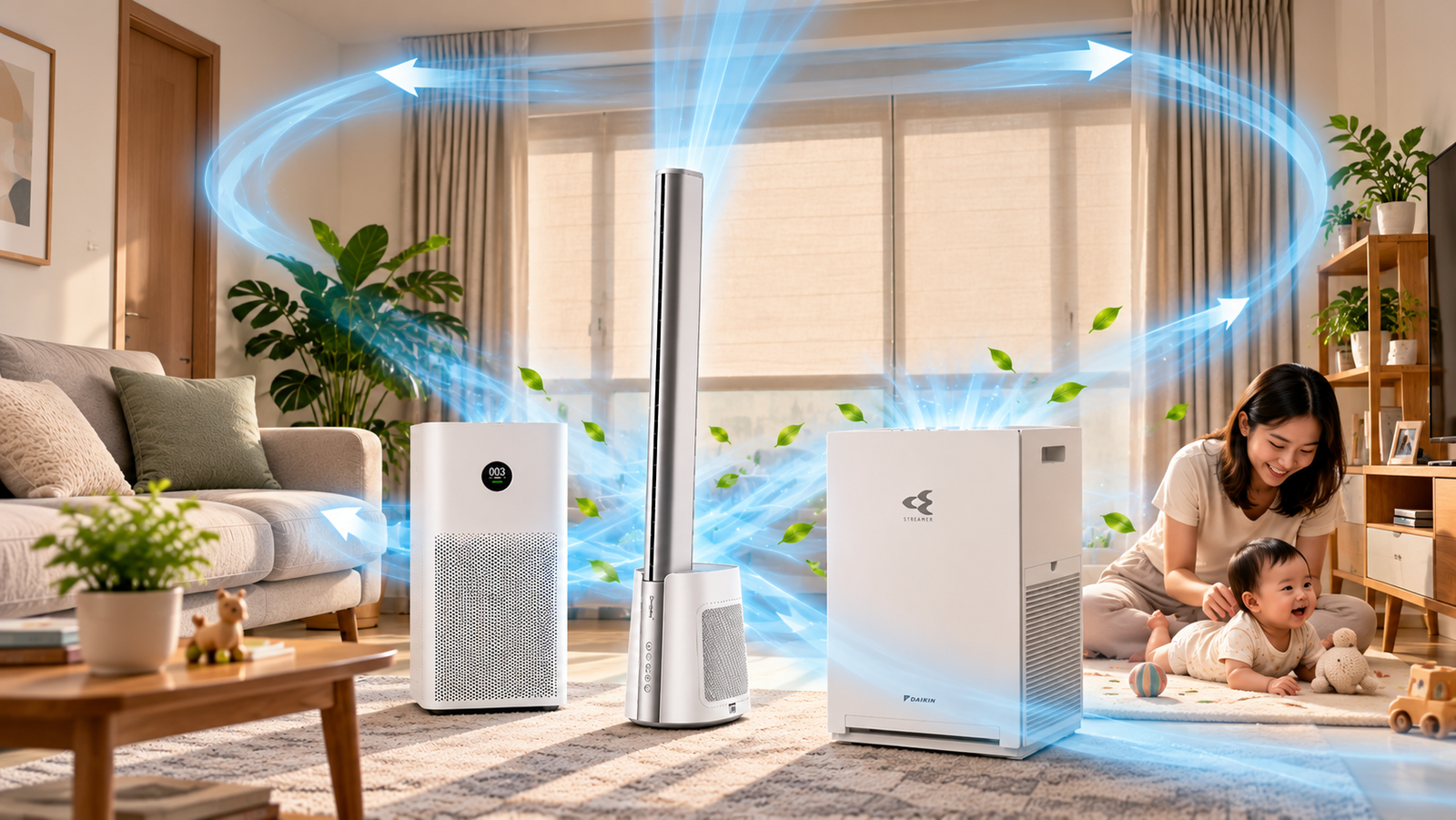
Disclosure: I bought my Xiaomi and Europace with my own money, and the Daikin was a gift from a friend. No brand has sent me anything in this post, and it isn’t sponsored. It may contain affiliate links to Shopee and Lazada; if you purchase through them, I may earn a small commission at no extra cost to you. All opinions here are my own, based on my own use and research.
We have a new infant at home. Just weeks old at the time of this post, lungs still developing, and spending most of her day asleep in our bedroom. And outside, the haze has been getting worse, week after week.
That combination made me think about the air at home more than I ever have. I kept wondering what the haze could be doing to her, and what I could actually do about it.
The haze in Singapore is back, and this year it’s not a light one. On 4 September, Singapore’s 24-hour PSI crossed into the Unhealthy range for the first time since October 2023. It’s only gotten worse since. On 9 October, it peaked at 192 in the central region, not far off the Very Unhealthy mark of 201, and as of 13 October it was still in the Unhealthy range across the island.
With a newborn and a toddler at home, that changes things. This is the second post in my newborn series, after my baby night light setup. It covers what’s causing the haze, why it matters more for little ones, and why an air purifier has become a must-have in our Singapore home this haze season, including the three already running. If you’re shopping for one, my air purifier Singapore buying guide picks up where this post leaves off, and it’s coming right up.
What’s Causing the 2026 Haze in Singapore?

The short version: fires in our neighbours’ backyard, and the wind blowing the smoke our way.
According to NEA’s updates, the smoke comes from fires in Kalimantan and southern Sumatra, where dry weather has kept the hotspots burning. When the prevailing winds blow from the southeast or south, they carry that smoke haze straight to Singapore. A shower here or there helps, but as long as the region stays dry and the winds don’t change, the risk stays. And the Meteorological Service doesn’t expect the dry season to end until late October or early November.
This year was flagged early, too. The Singapore Institute of International Affairs gave its 2026 Haze Outlook a rare Red rating, only the second since the outlook began in 2019, and marked August to September as the peak danger period. We’re now in the middle of October, and it hasn’t let up.
PSI or PM2.5: which number should you check?
Both are on haze.gov.sg and the myENV app, and they answer different questions:
- 24-hour PSI tells you how the past day has been, and NEA’s forecasts use it. Use it to plan ahead.
- 1-hour PM2.5 tells you what the air is like right now. Check it before heading out, or before opening the windows.
PM2.5 refers to fine particles 2.5 micrometres or smaller, the stuff in haze that gets deep into your lungs. It’s also the number your air purifier’s sensor is measuring, which comes in handy later.
How the Haze Affects Us, and Why Babies and Toddlers Are More Vulnerable
For most healthy adults, haze means itchy eyes, a scratchy throat, and maybe a cough. Annoying, but temporary. Young children are a different story.
The World Health Organization points to a few reasons children are more vulnerable to air pollution:
- They breathe faster than adults, so they take in more pollutants for their size.
- Their lungs, organs and brains are still developing, and a newborn is at the very start of that.
- They live closer to the ground, where some pollutants are more concentrated. Think of a baby on a playmat or a toddler crawling around.
I’m a dad, not a doctor. If your child has asthma or another heart or lung condition, or seems unwell during the haze, speak to your paediatrician.
What the official advice says
Here’s what I’ve taken away from MOH and doctors’ guidance:
- Keep children indoors as much as possible when the haze reaches unhealthy levels.
- N95 masks aren’t made for children. The government has said it will hand out N95 masks if the PSI reaches Very Unhealthy levels, but MOH has said they aren’t designed or certified for kids, because a proper seal is hard to get on smaller faces. Doctors are even more direct about babies: never put a mask on a baby.
- Close the windows, turn on the air-con, and run an air purifier. That’s the approach a paediatric specialist at NUH has recommended, and it’s the one we follow at home.
So for a newborn, the plan isn’t a mask. It’s keeping the air she breathes indoors as clean as possible. Which brings us to air purifiers.
My Current Arsenal: Our Air Purifiers for Singapore’s Haze
We already have three devices doing air duty at home, bought at different times for different reasons.
Daikin MC30YVM7
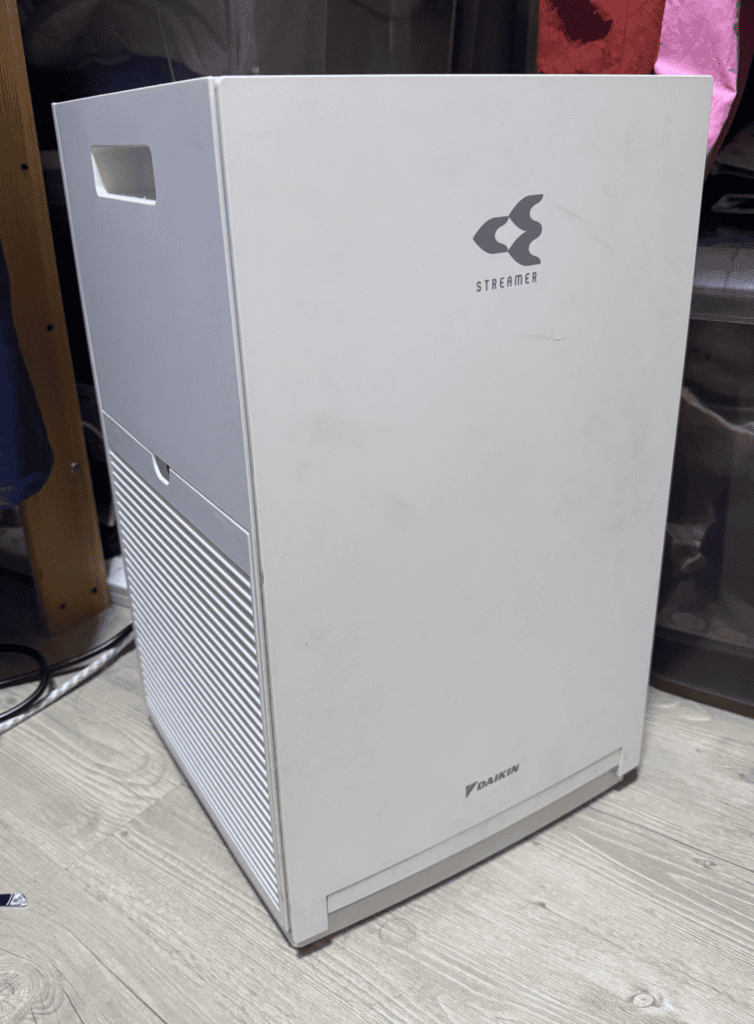
This one lives in one of our bedrooms, and it was a gift from a dear, dear friend.
| Daikin MC30YVM7 | |
|---|---|
| CADR | 180 m³/h |
| Room size | Up to 23 m² (cleaned in 30 minutes) |
| Filtration | Electrostatic HEPA filter (99.97% at 0.3 µm), plus a deodorising filter |
| Special tech | Flash Streamer |
| Noise | 19 dB (Silent) to 37 dB (Turbo) |
| Extras | Haze (PM2.5) mode, child lock |
| Filter life | Up to 10 years for the HEPA filter |
Daikin’s pitch is its Flash Streamer, which uses a plasma discharge to break down things like bacteria, allergens and odours, rather than just trapping them. Its electrostatic HEPA filter is also rated to last up to 10 years, which is unusual. Most purifiers need a new filter every 6 to 12 months.
For most of its life with us, there’s been no need to turn up the fan speed. On its lowest setting, it’s barely noticeable, which is exactly what you want in a room with a sleeping baby. I can’t say the same for the higher speeds, simply because I’ve never really had to use them.
It’s also the oldest air purifier in the house, and it shows. When I gave all of them a good clean a few weeks back, the Daikin’s filter had caught noticeably less dirt than the Xiaomi’s. More on why below.
Xiaomi Smart Air Purifier 4
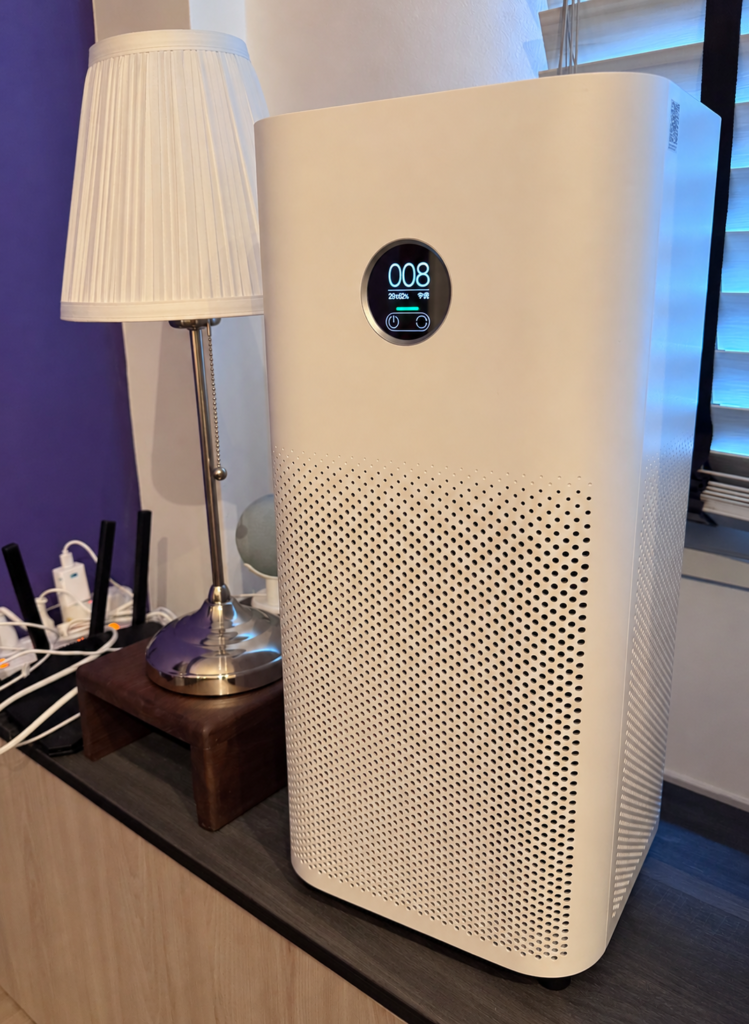
This one lives in our master bedroom, where the kids sleep at night. I bought it in October 2023 for about S$219, and it was actually meant for my mother-in-law. Somewhere along the way, it found its way into our room instead, and with a newborn and a toddler sleeping in there now, I’d say it ended up exactly where it needed to be.
| Xiaomi Smart Air Purifier 4 | |
|---|---|
| CADR | 400 m³/h |
| Room size | Up to 48 m² |
| Filtration | 3-in-1 filter: pre-filter, high-efficiency filter (99.97% at 0.3 µm), activated carbon |
| Sensor | Laser PM2.5 sensor with Auto mode |
| Noise | 32.1 dB (Sleep) to 63 dB (max) |
| Extras | OLED touchscreen, negative ion generator, Mi Home app, Google Assistant and Alexa |
| Filter life | 6 to 12 months |
Of the three, this is the heavyweight: the biggest filter and the fastest fan in the house. But what I really love about it is how smart it is, especially once it’s hooked up to Home Assistant (another topic for another day). With it, I can:
- Adjust the fan speed remotely, without getting out of bed or walking into the room.
- Set rules based on PM2.5. When the reading climbs past a certain number, the fan speeds up on its own, and it slows back down once the air clears.
- Track PM2.5 over time, over the last 24 hours, the last 7 days and so on, which is how I got the readings below.
- Dim or switch off the display on a schedule. At my place, it goes dark at 11pm, so there’s no glowing screen in the room when the kids are asleep.
The Daikin can’t do any of that. Next to the Xiaomi, it’s a traditional, “dumb” unit: you set it and leave it.
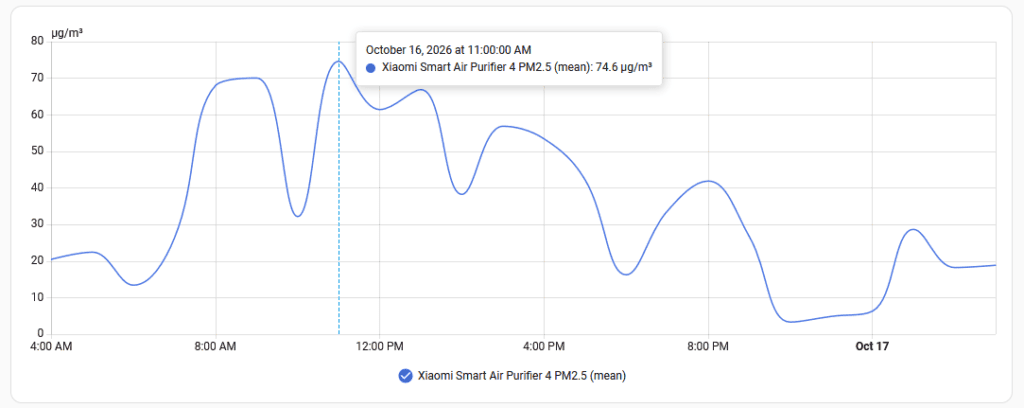
What the readings actually show. Over the last few days (as of 17 October 2026), even with the Xiaomi 4 running at full blast, the PM2.5 reading has swung anywhere from 30 to over 70 µg/m³ during the day, peaking at 74.6 µg/m³ at 11am on 16 October. It comes down for a while, then jumps back up again before easing off. For context, the World Health Organization’s guideline for 24-hour exposure is 15 µg/m³.
At night, it’s a different story. With the air-con on, and the windows and bedroom door closed, it drops into the single digits, with the odd spike in the small hours.
My takeaway: an air purifier can only do so much if haze keeps finding its way in. Closing up the room does as much of the work as the purifier itself, which is why I don’t rely on it alone during the day.
Europace EBFZ2WH: a fan with a filter
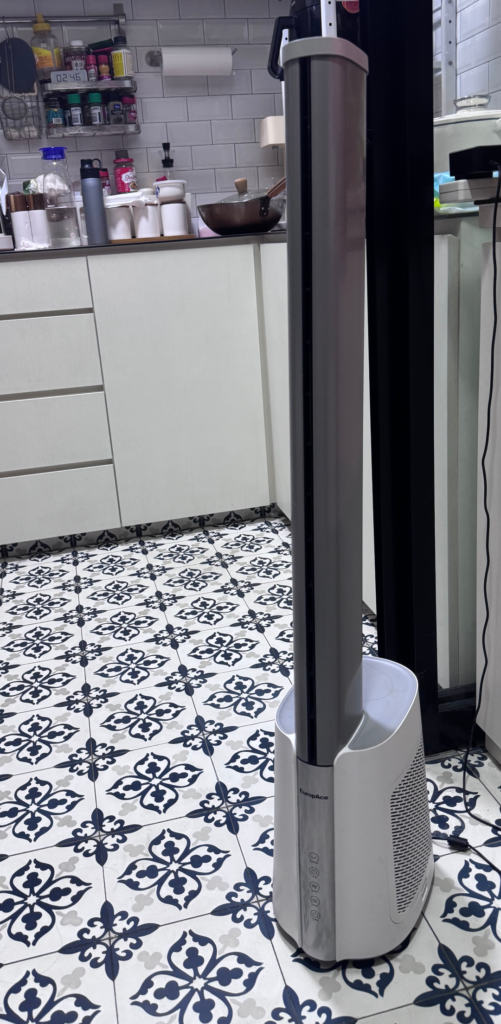
This one lives in our kitchen, where a fan is running most of the time, particularly when we’re not home. It’s practically the dedicated fan of Sophie, our dog. I bought it in October 2025 when our old fan broke down, for about S$200 with a two-year warranty.
| Europace EBFZ2 | |
|---|---|
| Type | Bladeless fan with HEPA filtration |
| Filtration | HEPA filter, rated to remove up to 99.60% of airborne particles |
| CADR | Not published |
| Motor | BLDC, up to 36 W |
| Noise | 42 to 60 dB |
| Extras | 12 speeds, 60°/90°/120° oscillation, remote control |
This one’s a bit different. It’s a fan first, with a HEPA filter built in, so the air it blows at you is filtered along the way. The bladeless design is a plus with a toddler around: no spinning blades for curious fingers.
But it’s worth being honest about what it isn’t, and the first thing that struck me is how little Europace tells you about the purifying side of things. Going through its own product page and the retailer listings, here’s what I found:
- No CADR. So there’s no way to tell how quickly it clears a room, or how big a room it’s meant for.
- No PM2.5 claims. Not a single mention of it, which is the one number that matters during the haze.
- Mixed messages on the filter. The product page says its “dual HEPA filters” remove up to 99.6% of airborne particles, short of the 99.97% of a True HEPA filter. Yet Europace’s own replacement filter listing describes an H13 HEPA filter that captures 99.97% of particles down to 0.3 microns. Which one is it? I honestly can’t tell you.
- No filter replacement interval. Not on the product page, not on the filter listing, and there’s no filter reminder on the fan itself.
That last one matters more than it sounds. Most HEPA filters in home purifiers and purifying fans are meant to be replaced every 6 to 12 months, and sooner if the unit runs all day, there’s a pet nearby, or you’re in the middle of a haze season. Ours ticks all three boxes. When I pulled the filter out during my last clean-up, about a year in, the pleats were matted with dust and fur. I can’t vouch for PM2.5 yet, but judging by the filter, it’s certainly catching Sophie’s fur. It’s also clearly overdue for a change, because a clogged filter chokes the airflow, so the fan works harder and cleans less.
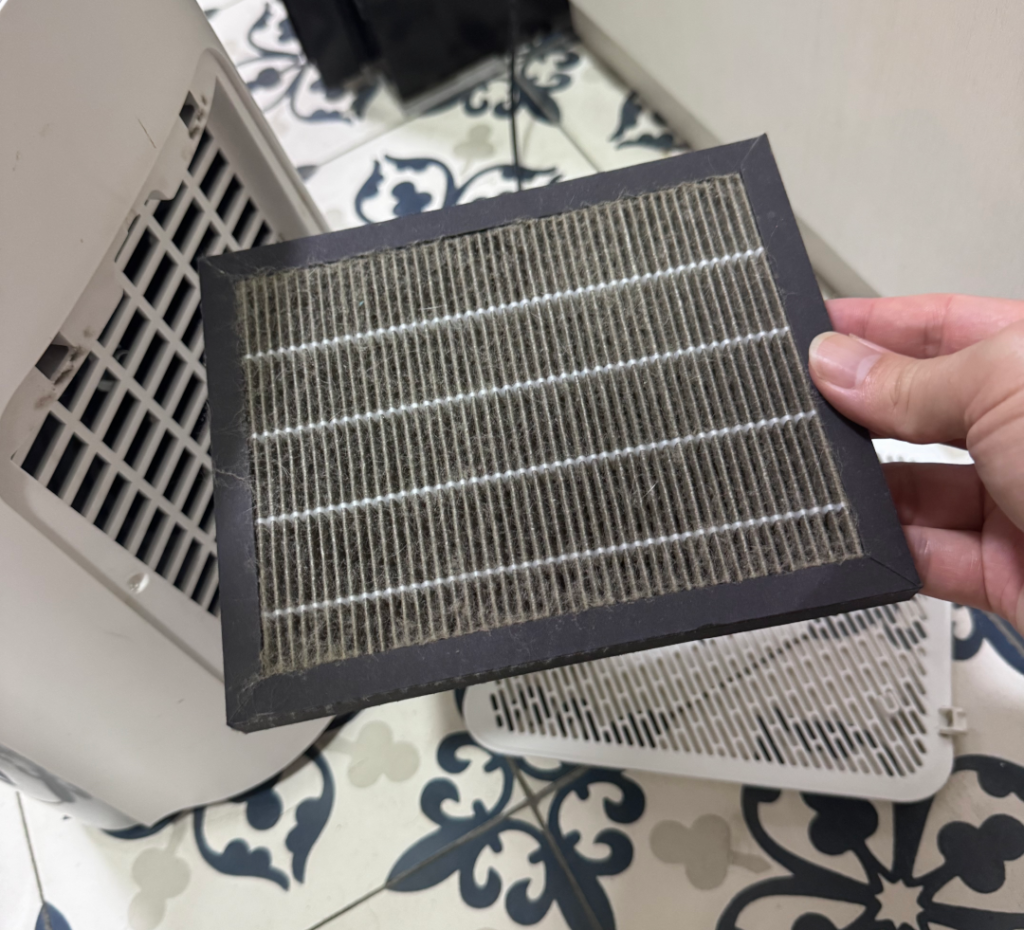
The good news: replacement filters aren’t hard to find. Europace sells an official filter pack for S$49.90, and you can also find them on Shopee and Lazada, or go cheaper with compatible ones on Taobao. And don’t bother washing a HEPA filter. Water damages the fibres. A gentle once-over with a vacuum brush will get the fur off between changes, but it won’t bring a tired filter back to life.
So put all that together, and the Europace is exactly what its name on the box suggests: a fan with an air purifying function, not an air purifier with a fan function. It’s a good fan, and the filter is a bonus. I’ll put it to a proper test once my PM2.5 sensor arrives.
What cleaning them taught me: an air purifier is just a fan and a big filter
Here’s something that becomes obvious once you’ve taken a few of these apart: strip away the app, the screen and the sensor, and an air purifier is essentially just a fan and a large filter. The fan pulls air in, and the filter catches what’s in it. That’s really it. The CADR figure every brand advertises comes down to how well those two work together: how much air the fan can move, and how much filter there is to push it through.
Which is also why the Europace is a fan with a filter, and the Xiaomi is a filter with a fan. Same two ingredients, very different priorities.
Cleaning the Xiaomi Air Purifier 4 and the Daikin side by side made this click. The Xiaomi’s filter is much, much, much bigger. It’s a tall cylinder that wraps all the way around, so air gets pulled in from every direction. Xiaomi says its high-efficiency layer alone has 22,000 cm² of filter area. The Daikin’s filter is a flat panel, and a lot smaller. [DAIKIN FILTER SIZE, OR A ROUGH COMPARISON] Pair that bigger filter with a faster fan, and it’s no surprise the Xiaomi’s CADR is more than double the Daikin’s, or that its filter came out the dirtier of the two.
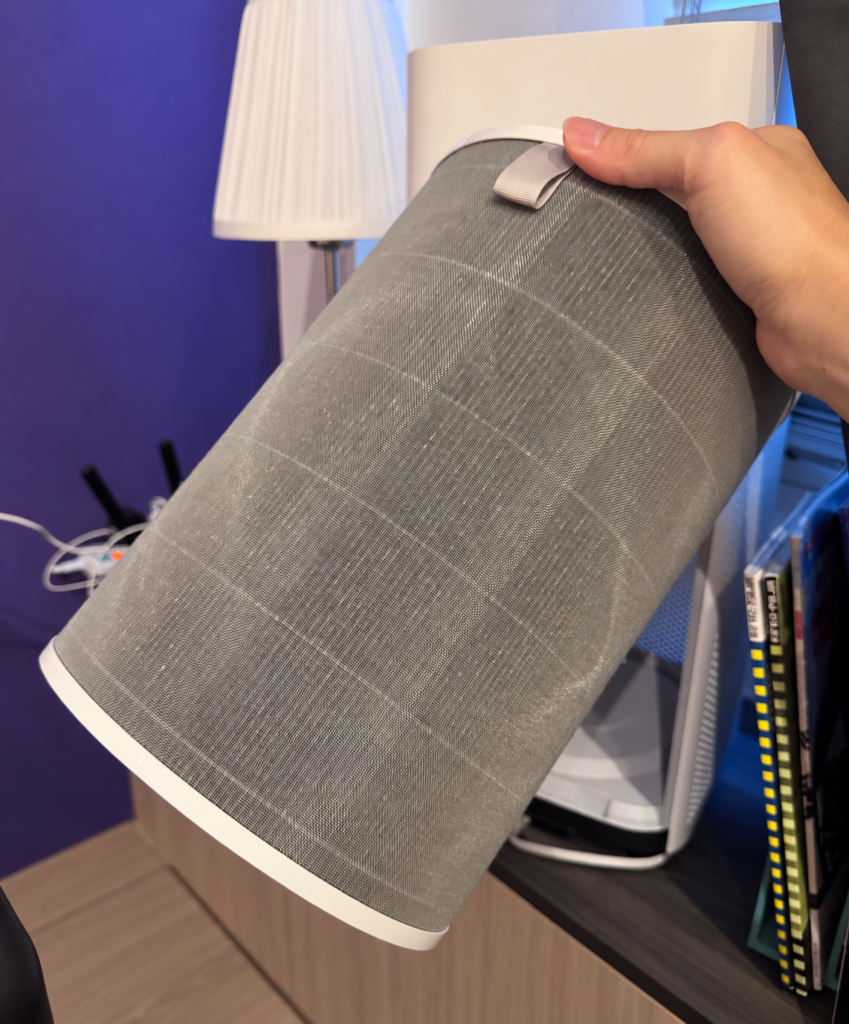
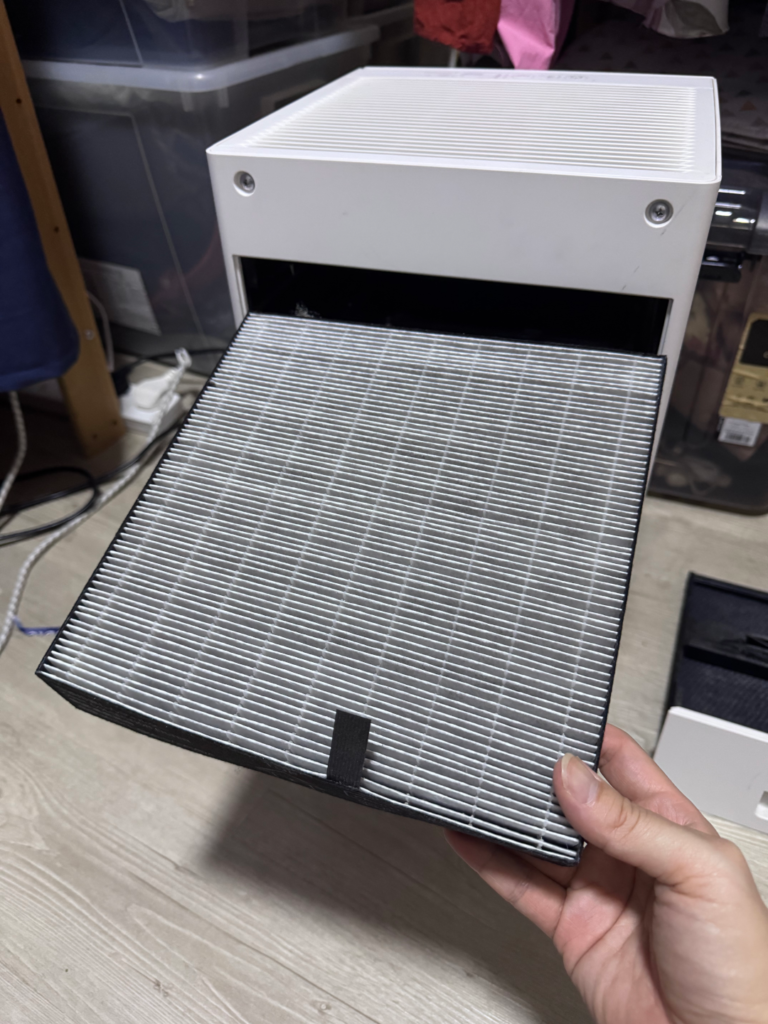
That’s not just a curiosity. Filter size and airflow design make a real difference to how a purifier performs:
- More filter area means less resistance. Spread the same amount of air over a bigger filter, and it passes through each part more slowly. The fan doesn’t have to work as hard, which usually means less noise for the same amount of clean air.
- A bigger filter holds more before it clogs. More surface area means more room to trap particles, which helps the filter last longer between replacements, something that matters a lot during a long haze season.
- 360° intake is more forgiving on placement. A cylindrical design like the Xiaomi’s draws air from all sides and pushes clean air out of the top, so it works well wherever you put it. A purifier that only draws air from one side needs that side kept clear, and can struggle if it’s pushed against a wall or tucked behind furniture.
How air moves through a purifier. Dirty air comes in through the intake, passes through the pre-filter (hair and dust), then the HEPA layer (fine particles like PM2.5), then the activated carbon (smells and gases), and finally the fan pushes clean air out of the outlet. Outlets that blow upward help spread clean air around the room instead of letting it get sucked straight back into the intake.
Placement tips that follow from this:
- Leave a gap between the purifier and the wall, especially on the intake side.
- Avoid tucking it into a tight corner or behind a sofa.
- Keep the outlet clear, and don’t cover the top with anything, no matter how convenient a flat surface it looks. Toddlers do like to put things on top of things.
Our Setup, and What’s Next
The haze isn’t something we can control, but the air inside our home is. For us, that means keeping the kids indoors on bad days, windows shut, air-con on, and an air purifier running in the rooms they spend time in. Right now, that’s the Daikin and the Xiaomi Air Purifier 4 in the bedrooms, and the Europace keeping Sophie company in the kitchen.
With the haze dragging on, I’m planning to add another air purifier or two (I’m eyeing the Xiaomi Smart Air Purifier 4 Pro), starting with the living room. What should you look for? How big does it need to be? And how do nine popular air purifiers stack up against my own criteria? That’s all in my air purifier Singapore buying guide – coming right up!
Stay safe, keep an eye on the PSI, and more from the newborn series soon.