
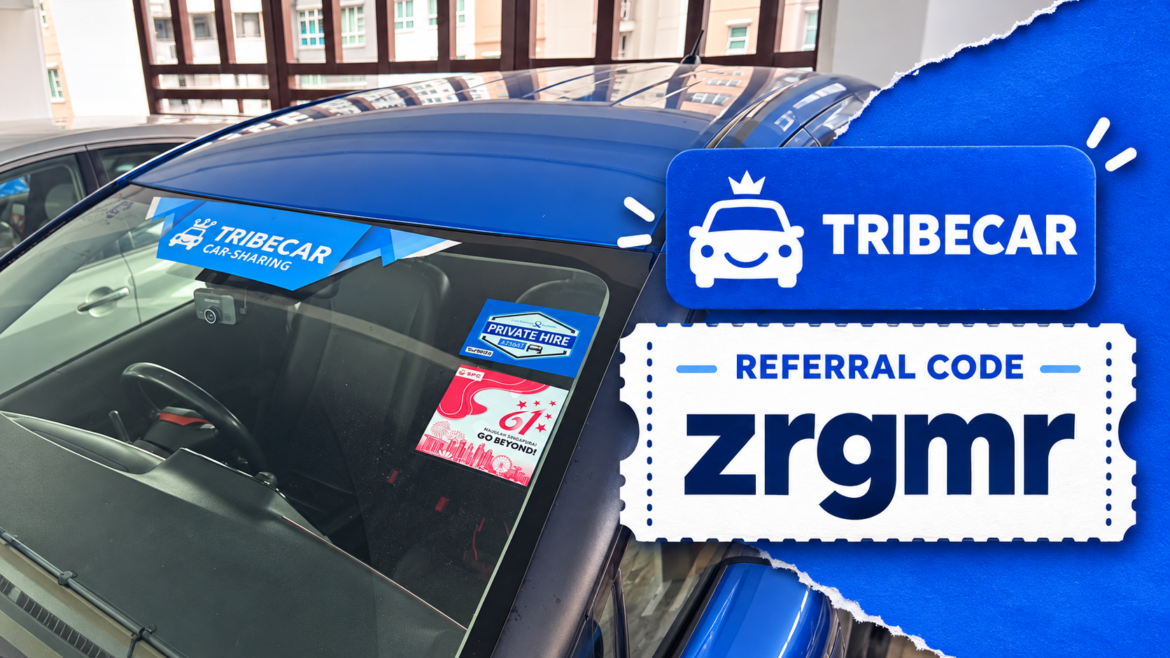
When I came back to Tribecar this month, I reactivated my old account. So no referral code for me, and no $15 in free credits. If you’re signing up for the first time, you’re luckier than me.
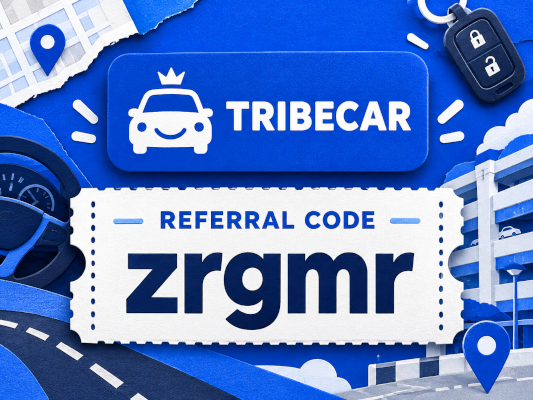
So use my Tribecar referral code zrgmr, or sign up with my referral link so it’s filled in for you. Once you make your first e-wallet top-up of at least $50, we both get $15 in e-wallet credits.
Want to know what Tribecar is actually like before you sign up? I’ve written a full Tribecar review covering my first drive, the costs and how it compares with GetGo.
Tribecar Referral Code: zrgmr
| Referral code | zrgmr |
| Referral link | Sign up here |
| What you get | $15 in e-wallet credits |
| What I get | $15 in e-wallet credits |
| Condition | Your first e-wallet top-up must be at least $50, in a single transaction |
| Where to enter it | During sign-up |
How Tribecar’s Referral Programme Works
It’s simple. According to the referral page in the Tribecar app:
- You sign up using a referral code or link.
- You make your first e-wallet top-up of at least $50.
- We both get $15 in e-wallet credits.
That’s it. No minimum number of trips, no minimum booking value. The trigger is the $50 top-up.
Watch out: Tribecar lets you top up as little as $20, in multiples of $10. But the referral needs your first top-up to be $50 in a single transaction. Tribecar’s support team confirmed this to me. Top-ups don’t add up, so $20 followed by $30 won’t count. Make your first top-up $50 or more.
Stack It with TCWELCOMEU for Another $15 Off
Tribecar also runs a new joiner promo code, TCWELCOMEU, which gets you $15 off your first booking. It’s valid until 31 Dec 2026.
The two are entered at different steps:
- zrgmr (referral code) goes in during sign-up
- TCWELCOMEU (promo code) goes in when you book
So there shouldn’t be any conflict between them. Use both, and that’s up to $30 off as a new user: $15 in credits plus $15 off your first booking.
I can confirm TCWELCOMEU works, because $15 came off my first booking after reactivating. Fair warning: the promo banner says “15% off”, but it’s actually $15 off.
How to Use the Tribecar Referral Code
- Use my referral link, or download the Tribecar app from the App Store or Google Play.
- Sign up. Using SingPass makes it quick, and Tribecar pulls your licence details automatically.
- Enter referral code zrgmr when signing up, if it isn’t already filled in. Do it here, because this is the step where the code goes in.
- Pay the security deposit, if it applies to you. I paid $100 as a new driver.
- Top up your e-wallet with at least $50, in one go. This triggers the $15 credits for both of us.
- Book your first car and enter promo code TCWELCOMEU at checkout for $15 off.
Tribecar referral code zrgmr
Before You Top Up: Know This
The $50 top-up has a catch worth knowing about. Tribecar’s e-wallet credits are non-refundable, even if you close your account later. Only the security deposit comes back.
So top up $50 only if you’ll actually use Tribecar. How far does it go? Here’s what it gets a new driver like me, based on my own receipt for a 4-hour weekday trip in a Toyota Sienta Hybrid.
Your $50 top-up plus $15 referral credits gives you $65 to spend:
| Without optional add-ons | With TribeShield and PAI (like me) | |
|---|---|---|
| First 4-hour trip (with TCWELCOMEU) | $16.35 | $20.34 |
| Second 4-hour trip | $32.70 | $36.69 |
| Left in your wallet | $15.95 | $7.97 |
So that’s two 4-hour trips, with some change left over. Each trip includes:
- Rental: $6 an hour for my Sienta
- New driver surcharge: 20% of the rental, as shown on my receipt (Tribecar’s FAQ says 30%)
- Platform fee: $1.20 per booking
- GST: 9%
- Optional add-ons, if you choose them: TribeShield excess cover ($2.56 for 4 hours) and Personal Accident Insurance ($1.10)
Two things aren’t included. Petrol is on you for “no mileage fee” cars like mine, and I spent $10. And late fees: I also paid $10.90 for returning the car 11 minutes late, which I’ve left out because you won’t be late. Right?
Rates vary by car, day and time, so treat this as a ballpark. Experienced drivers skip the 20% surcharge, so your $65 goes a little further.
Quick Checklist: Ready for Your First Tribecar Drive?
Lessons from my own first drive, mistakes included:
- Referral code zrgmr entered at sign-up
- At least $50 topped up in a single transaction, to unlock the $15 credits
- TCWELCOMEU entered when booking
- Booked more than 48 hours ahead, so you can cancel for $0.88 if you get an old car
- Your own topped-up cash card. Tribecar doesn’t provide one
- Charging cables for your phone
- A plan to refuel earlier, not at the last minute. There’s no grace period on late returns
- Pay for fuel by card and keep the receipt. I didn’t, and regretted it
- Time to take photos before and after your trip
Frequently Asked Questions
Can I use more than one referral code? No. You enter one referral code at sign-up.
Can I add a referral code after signing up? No. Tribecar says you have to sign up for a new account through a referral link, or enter the referral code during registration.
Can my top-ups add up to $50? No. Tribecar’s support team confirmed that your first top-up must be $50 in a single transaction. Splitting it into $20 and $30 won’t qualify.
Can I stack the referral code with TCWELCOMEU? They’re entered at different steps: the referral code at sign-up, the promo code at booking. So there shouldn’t be any conflict. You should get both.
Does it matter whose referral code I use? Not for you. You get the same $15 whichever code you use. Using mine supports this blog, which I appreciate.
When do I get the $15 credits? Once your first top-up of $50 or more goes through. Tribecar says the $15 is credited automatically to both our e-wallets.
Do the credits expire? Tribecar says credits don’t expire while your account is active. But it may close accounts that have been inactive for 2 years.
Can I get my e-wallet credits back if I close my account? No. E-wallet credits are non-refundable. Only the security deposit is refunded, which can take up to 45 working days.
Is there a deposit? I paid a $100 security deposit as a new driver. I can’t confirm whether experienced drivers pay it too.
Can P-plate drivers join Tribecar? Yes. Tribecar accepts drivers from 18 to 65, including P-plate holders. New drivers pay a surcharge and get a more limited choice of cars. GetGo doesn’t accept P-plate drivers under 25.
Is fuel included? It depends on the car. “No mileage fee” cars like my Sienta mean you pay for your own fuel. FlexiFuel cars let you choose between a mileage charge and paying for your own fuel.
How much does Tribecar cost? My Toyota Sienta Hybrid was $6 an hour before the new driver surcharge, add-ons and GST. A 4-hour trip for a new driver works out to about $33 to $37, or $16 to $20 with TCWELCOMEU. The full breakdown is in my Tribecar review.
Do I have to return the car where I picked it up? Yes. Tribecar is point A-to-A, like GetGo.
Can I drive a Tribecar into Malaysia? Yes, with selected cars and a minimum 6-hour booking, but not as a new driver. There’s a 30% surcharge on the rental and a $200 pre-authorisation hold.
What is the Tribecar hotline number? Tribecar’s 24-hour emergency hotline is for breakdowns and emergencies only. Reach it in the app via Need Help on your Account page, then Emergency. For referral or account questions, email support@tribecar.com or use the live chat.
Ready to Sign Up?
Use Tribecar referral code zrgmr or sign up with my referral link, top up at least $50, and we both get $15 in credits. Then enter TCWELCOMEU when you book for $15 off your first trip.
Still deciding? Read my full Tribecar review first, or see how it compares in my GetGo car sharing guide. Already using GetGo? My GetGo referral code gets you $8 off your first drive.
Disclaimer: Referral and promo terms are based on the Tribecar app and help centre as of October 2026, and may change. Always check the app for the latest terms. I earn $15 in credits when readers use code zrgmr, but I only recommend services I actually use myself. Looking for more codes? Check out my Referral Codes Singapore page.