Disclosure: I bought my Xiaomi and Europace with my own money, and the Daikin was a gift from a friend. No brand has sent me anything in this post, and it isn’t sponsored. It contains affiliate links to Shopee and Lazada; if you purchase through them, I may earn a small commission at no extra cost to you. All opinions here are my own, based on my own use and research.
In my last post on why we run an air purifier in Singapore’s haze, I covered what’s causing this year’s haze, why it matters more for newborns and toddlers, and the three air purifiers already running in our home. With the haze dragging on, I’m now shopping for more, starting with the living room.
So this post is my buying guide for anyone choosing an air purifier in Singapore: what to look for, how big it needs to be for an HDB room, what sets the brands apart, my own criteria, how the ten air purifiers I looked at stack up against them, and what I’m buying next. It’s the third post in my newborn series.
What to Consider When Buying an Air Purifier in Singapore
Here’s what I look for, especially with the haze in mind.
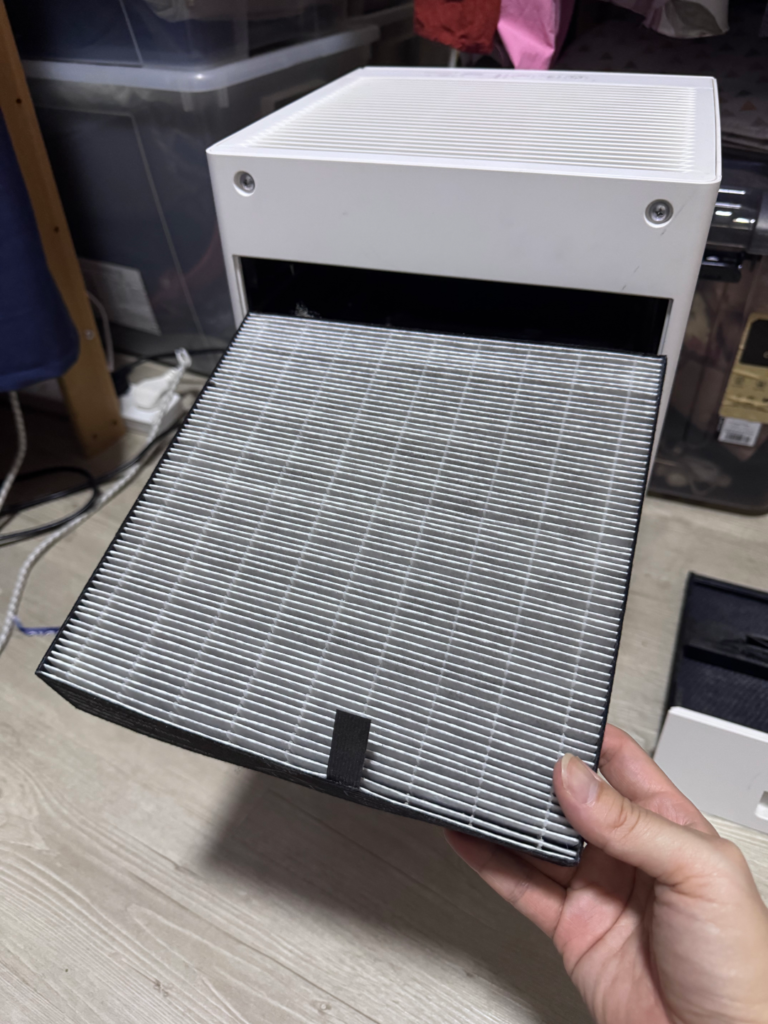
1. A True HEPA filter, and activated carbon is a plus. For haze, you want a filter that catches at least 99.97% of particles at 0.3 microns, often labelled H13. Be wary of vague terms like “HEPA-type”. Activated carbon is a big, big plus: HEPA traps the particles, while carbon handles the smoky smell.
2. Enough CADR for the room. CADR (clean air delivery rate) is how much clean air the purifier puts out per hour. More on how to size it below.
3. A PM2.5 sensor and Auto mode. A good sensor lets the purifier ramp up when the haze rolls in and quiet down when it clears, without you touching it. It also lets you see whether it’s actually working.
4. Quiet at night, with a display you can turn off. Check the noise level at the lowest speed, not just the headline figure (more on why in the sizing section below), and whether the lights can be dimmed or switched off. After all the effort I put into a dim night light setup, a glaring purifier display would undo it.
5. No ozone. Some purifiers use ionisers or other electronic air-cleaning technologies that can release ozone as a by-product, and a few are designed to produce it on purpose. Ozone irritates and inflames the lining of the airways, causing coughing and chest tightness, and it can worsen asthma. California’s Air Resources Board lists children among those most vulnerable to it, for the same reasons they’re more vulnerable to haze: they breathe faster, and their lungs are still developing. The last thing you want is a purifier that swaps one lung irritant for another in a newborn’s room. Look for purifiers marketed as ozone-free, or check whether an ioniser can be switched off. My Xiaomi Air Purifier 4 has a negative ion generator too, but you can switch it off in the app if you’d rather not have it running.
6. Toddler-proofing. A child lock, a stable base that won’t tip over when pushed, and no gaps for little fingers.
7. Filter cost and availability. The purifier is a one-off purchase. The filters aren’t. Check what replacements cost and where you’ll buy them. More on official vs Taobao filters below.
8. Smart home integration. App control, schedules, and Google Assistant or Alexa support. Being able to say “Hey Google, turn on the air purifier” with a baby in your arms is the same win as the smart plug in my night light post. The best part, though, is automation. My Xiaomi Air Purifier 4’s laser sensor tracks PM2.5 in real time and ramps up the fan speed when the reading rises, then eases off when the air clears. When the haze rolls in overnight, it reacts before I’ve even checked the PSI. Beyond Auto mode, the Mi Home app lets you set your own rules, like turning the fan up for a few hours when PM2.5 hits 12, or switching the display off at night. I run mine through Home Assistant (as I shared in my previous post), but that’s my own rabbit hole. You don’t need to go down it to get these features.
9. Local warranty. A unit bought from a local distributor is easier to service than a grey import.
10. Filter size and airflow design. Bigger filters and 360° intake generally mean quieter operation, longer filter life and more flexible placement.
Money-saving tip: use your Climate Vouchers if you haven’t. Under the Climate Friendly Households Programme, eligible households can claim up to S$400 in Climate Vouchers, redeemable until 31 December 2027. They’re meant for energy- and water-efficient products, and some air purifiers qualify. Gain City, for example, lists air purifiers like the Levoit Vital 200S and Dyson’s Hushjet as eligible, and Europace has its own list of eligible purifying fans. Eligibility is model-specific, so check the official list or look for the Climate Voucher label before you buy. One catch: a transaction can only contain eligible products, so check out your air purifier separately from anything else. You can use Climate Vouchers on e-commerce platforms too, but only at selected shops, so check the listing or with the merchant before you add to cart.
How big an air purifier do you need?
A common rule of thumb is to aim for around 4 to 5 air changes per hour (ACH), meaning the purifier can filter the room’s entire volume of air 4 to 5 times an hour. To work it out:
ACH = CADR ÷ (floor area × ceiling height)
Here’s how that looks for typical HDB rooms, assuming a ceiling height of about 2.6 m. Room sizes vary by flat type and era, so measure yours, or use the calculator below to work it out for your own room.
How much CADR does your room need?
Enter your room size to get a recommended CADR, and see which purifiers in my shortlist are up to the job.
| Air purifier | Air changes per hour | CADR |
|---|
Based on 4 to 5 air changes per hour (ACH), aiming for 5 to give a bit of headroom so the purifier can run quieter. Stated CADR is measured at the highest fan speed, and a purifier built for a much bigger space can still be audible on its lowest setting, so match it to your room rather than buying the biggest one. CADR figures are the manufacturers’ own.
| Room (approx. size) | Daikin MC30YVM7 (180 m³/h) | Xiaomi Air Purifier 4 (400 m³/h) | Xiaomi Air Purifier 4 Pro (500 m³/h) |
|---|---|---|---|
| Common bedroom (12 m²) | 5.8 ACH | 12.8 ACH | 16.0 ACH |
| Master bedroom (16 m²) | 4.3 ACH | 9.6 ACH | 12.0 ACH |
| Living and dining (35 m²) | 2.0 ACH | 4.4 ACH | 5.5 ACH |
A note if you’re new to air purifiers: the stated CADR is almost always measured at the highest fan setting, which is also the loudest. So there’s a direct trade-off between how fast a purifier cleans the air and how much noise it makes. On sleep mode, the real CADR is much lower.
What’s less obvious is fan size. Generally, a bigger fan can move the same amount of air as a smaller one while spinning slower, and slower means quieter. That’s why a larger purifier running on a medium setting can be quieter than a compact one flat out, while cleaning just as much air. Fan size isn’t the only factor, since blade design, motor quality and the airflow path all play a part, but it’s a big one.
The practical takeaway: buy a bit more CADR than your room strictly needs. That headroom lets the purifier do the job on a lower, quieter setting, which matters most in a bedroom where a baby sleeps. Just don’t overdo it. Models built for much bigger spaces usually come with a bigger, more powerful fan, and even on the lowest setting, that fan can still be audible. So a purifier sized for a living room isn’t always the quietest pick for a bedroom. Match it to your room rather than simply buying the biggest one you can afford.
Close up the room, too. In my previous post, I shared that our Xiaomi Air Purifier 4 swings between 30 and over 70 µg/m³ during the day, even at full blast. At night, with the air-con on and the windows and bedroom door closed, it drops into the single digits. Headroom helps, but sealing the room matters just as much.
What Sets the Big Brands Apart
Most air purifiers use some combination of a pre-filter, a HEPA filter and activated carbon. So what gives you a reason to pick one brand over another? Here’s what each one is known for.
Daikin: Flash Streamer and a 10-year filter. Daikin’s Streamer technology aims to break down pollutants rather than just trap them, and its electrostatic HEPA filter is rated to last up to 10 years. On paper, that changes the running-cost maths completely. Personally, I’m sceptical. HEPA filters clog up with use, and I believe they need changing every 6 to 12 months, whatever the box says.
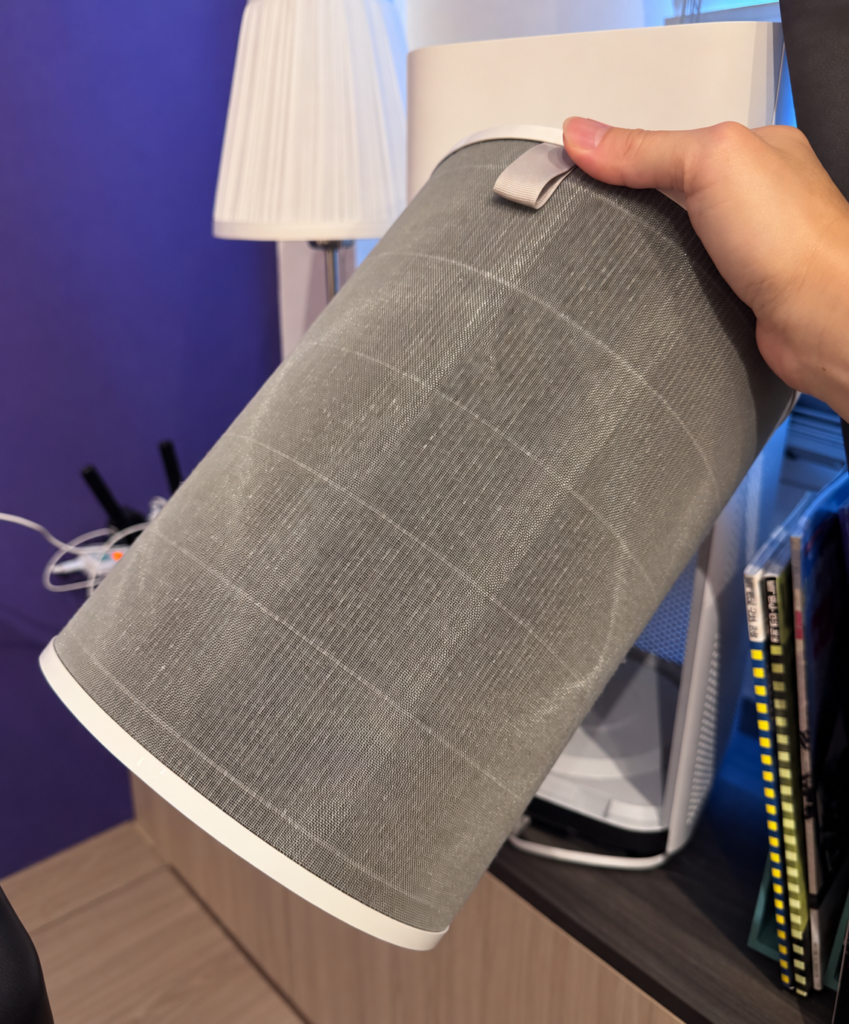
Xiaomi: value, sensors and the smart home. Xiaomi packs a laser PM2.5 sensor, a touchscreen display and Mi Home app control into purifiers that are usually cheaper than rivals with similar CADR. Its cylindrical, 360° filters are big, and replacements, especially third-party ones on Taobao, are easy to find and affordable.
Philips: NanoProtect HEPA and AeraSense. Philips says its NanoProtect HEPA filter uses an electrostatic charge to attract particles, cleaning up to twice as much air as a traditional H13 filter. Its AeraSense sensor is pitched as professional-grade, picking up particles even smaller than PM2.5.
Levoit: quiet and ozone-free. Levoit’s QuietKEAP technology brings sleep mode down to around 22 dB, and its AirSight Plus laser sensor drives Auto mode. Levoit also says its purifiers don’t use UV or ionisers, so they’re ozone-free, which ticks one of my boxes straight away.
LG: 360° design and the Clean Booster. LG’s PuriCare 360° range draws air in from all around, like the Xiaomi, and adds a Clean Booster fan on top that pushes clean air further across the room, up to 7.5 m in LG’s testing. It uses a PM1.0 sensor, which picks up even finer particles than PM2.5, and works with LG’s ThinQ app. LG also makes the AeroTower, which combines a fan and an air purifier.
Novita: built for Singapore’s humidity. Novita is a homegrown brand, and it shows in the product line. Alongside regular H13 air purifiers, it makes 2-in-1 dehumidifier and air purifier units, which make a lot of sense when our average humidity sits around 80%. The A11i, for example, pairs an H13 filter with a CADR of 440 m³/h, right in the same class as the Xiaomi Air Purifier 4, and Novita offers 3 years of warranty on the brushless DC motor.
Europace: a quiet rebrand, and haze-focused purifiers. Europace feels like it’s had an unofficial rebrand: better designs, better specs and, going by reviews, better reliability than the Europace I remember. Its HazePRO range are dedicated air purifiers built around PM2.5, with H13 HEPA and activated carbon filters. The EPU5530B, for example, adds 360° intake, a CADR of 530 m³/h, UV sterilisation and a child lock.
One pattern worth noticing: ions. Novita, Europace and LG all advertise ioniser technology on at least some models, and so do Xiaomi’s Air Purifier 4 and 6. If you’re buying for a baby’s room, check whether the ioniser can be switched off before you buy, not after.
A homegrown newcomer: Sterra
Sterra is a Singapore brand launched in 2021. It started with water purifiers before moving into air purifiers, and it now has showrooms in Ubi, NEX and Tampines Mall, which makes after-sales support easy to reach. Its purifiers use HEPA-13 or HEPA-14 filters at competitive prices. The Breeze Pro is the one that caught my eye: an H14 filter and a CADR of 500 m³/h, the same as the Xiaomi Air Purifier 4 Pro, for less money.
I’m including Sterra because it’s clearly dedicated to this category, but with a caveat. It’s only been around for a few years, and I’m careful about recommending brands without a longer track record. Its marketing is also bold: claims like being Singapore’s number one air purifier brand are worth taking with a pinch of salt. And note that its models use ion and UV technology, so the same ioniser question applies. On the Breeze Pro, at least, you can switch each one on or off. If you’re considering one, visit a showroom and ask about filter prices and the warranty.
My Own Criteria
Of everything on the checklist at the top of this post, seven are must-haves for our home. They’re also the columns in the ratings table further down:
- A HEPA filter rated at 99.97% for 0.3-micron particles, because PM2.5 is what the haze is made of.
- Enough CADR for the room, with a bit of headroom.
- A PM2.5 reading on the display, so I can check the air at a glance without opening an app.
- A display that dims and switches off completely. Dimmed for the living room, off for the bedrooms.
- An ioniser I can switch off, if it has one.
- Proper smart automation: custom rules, not just Auto mode.
- Replacement filters under S$20. Filters are the real long-term cost, and this is where Taobao comes in.
Official filters vs Taobao
Official Xiaomi filters aren’t cheap, and for my Air Purifier 4, they aren’t even easy to find. At the time of writing, Xiaomi’s official store on Lazada doesn’t carry a replacement filter for the Air Purifier 4 at all. It does stock filters for its siblings, and the prices tell you everything:
| Replacement filter | Xiaomi official store (Lazada) | Taobao (excluding shipping) |
|---|---|---|
| Xiaomi Air Purifier 4 Lite | S$55.90 | About S$18 |
| Xiaomi Air Purifier 4 Pro | S$75.90 | About S$25 |
| Xiaomi Air Purifier 4 and 6 (same filter) | Not available | About S$20 |
For reference, the genuine Air Purifier 4 filter goes for HK$229 in Hong Kong and about A$49 in Australia, which works out to roughly S$38 to S$42.
So on Taobao, you’re paying roughly a third of the official price. That’s how I keep filters under S$20. But Taobao comes with its own risks, like counterfeit filters that look identical to the real thing. I’ll cover how I pick a seller, what to check in the reviews and which certifications to look for in an upcoming post.
How the Air Purifiers Stack Up Against My Criteria
These are the nine air purifiers I looked at while shopping for our living room, plus the Xiaomi Air Purifier 6, which I’ve added because the Air Purifier 4 is out of stock. Three of them are ones I already own (the Xiaomi Air Purifier 4, the Daikin MC30YVM7 and the Europace EBFZ2), so I rated them alongside the rest to see how they hold up. Owning one doesn’t mean I’d recommend it, and two of mine didn’t make the cut. The others I haven’t used myself, so those ratings are based on research rather than hands-on experience.
Here’s how they measure up against my own criteria, sorted by my rating. ✅ means it meets the criterion, ❌ means it doesn’t, and ❓ means I couldn’t confirm it, so check before you buy.
| Air purifier | 99.97% HEPA filter | CADR (m³/h) | PM2.5 on display | Display dim and off | Ioniser can be switched off | Smart automation | Filters under S$20 | Price (Oct 2026) | My rating, and who it’s for |
|---|---|---|---|---|---|---|---|---|---|
| Xiaomi Air Purifier 4 | ✅ | 400 | ✅ | ✅ Normal, dim and off | ✅ Toggle in the app | ✅ Mi Home, Home Assistant | ✅ Third-party on Taobao | Out of stock (see the Air Purifier 6 below) | ★★★★★ Bedrooms. Ticks every one of my boxes |
| Xiaomi Air Purifier 6 | ✅ 99.98% at 0.3 µm | 443 | ✅ Plus PM1 and PM10 | ✅ On, dim and off | ✅ Toggle in the app, along with UV | ✅ Mi Home (Home Assistant ❓) | ✅ Same filter as the Air Purifier 4 | S$228 to S$244 🏬 Shopee · Lazada | ★★★★★ Bedrooms. Ticks the same boxes as the Air Purifier 4, and you can actually buy it |
| Xiaomi Air Purifier 4 Pro | ✅ | 500 | ✅ | ✅ Bright, dim and off | ✅ Toggle in the app | ✅ Mi Home, Home Assistant | ⚠️ About S$25 on Taobao (S$75.90 official) | S$347 to S$380 🏬 Shopee · Lazada | ★★★★½ Living rooms. My pick for ours |
| Levoit Vital 200S | ⚠️ Levoit calls it HEPA-grade, not certified True HEPA | About 430 | ❌ Colour ring only | ✅ Off, turns off automatically in the dark | ✅ No ioniser at all | ✅ VeSync app, Home Assistant | ⚠️ Official filter S$89.90. Third-party ones are cheaper | S$344 to S$354 🏬 Shopee · Lazada | ★★★★☆ Parents who want an ozone-free, set-and-forget bedroom purifier |
| LG PuriCare 360° Hit | ✅ H13 | 480 | ❌ Colour indicator only | ❓ | ❓ Has an ioniser | ✅ ThinQ app | ❓ | S$399 | ★★★½☆ Living rooms, and homes already on LG’s ThinQ app |
| Europace HazePRO EPU5530B | ✅ H13 | 530 | ⚠️ Three-colour indicator (number ❓) | ❓ | ❓ Has an ioniser (Super Eco Ion) | ❌ No app | ❓ | S$330 | ★★★☆☆ Large rooms on a budget, when it’s on sale |
| Novita A11i | ✅ H13 | 440 | ✅ | ❓ | ❓ Built-in plasma ioniser | ❌ No app | ❓ Filter rated for up to 24 months | S$258 (Novita, sold out) | ★★★☆☆ Bedrooms on a budget, if you don’t need smart features |
| Sterra Breeze Pro | ✅ H14 | 500 | ❌ Indicator ring only | ✅ Ring turns off in sleep mode | ✅ Ion and UV each switch on or off | ✅ SmartLife app (Home Assistant ❓) | ❓ Not listed (the Breeze’s filter is S$65) | S$329 (Sterra, pre-order) | ★★★☆☆ Living rooms. The closest rival to the 4 Pro on paper, if you’re comfortable with a newer brand |
| Daikin MC30YVM7 | ✅ | 180 | ❌ | ⚠️ Adjustable indicator brightness (off ❓) | Not an ioniser: uses Flash Streamer | ❌ No app | ⚠️ Daikin claims up to 10 years. I’d still replace it every 6 to 12 months | Not listed right now | ❌ Not recommended. I don’t buy the 10-year filter claim, and it’s not smart |
| Europace EBFZ2 (fan) | ❌ 99.60% | Not published | ❌ | ❌ | No ioniser | ❌ Remote only | ❌ S$49.90 official, no replacement interval given | About S$200 (what I paid in Oct 2025) | ❌ Not recommended as an air purifier. It’s a fan with an air purifying function |
My ratings reflect my own priorities: PM2.5 performance first, a display that won’t light up a dark nursery, no ions I can’t switch off, proper smart automation, and cheap filters. If ozone-free matters more to you than anything else, the Levoit is the safest bet.
Why I’m not recommending two of my own. The Daikin was a lovely gift, and it’s quiet, but as I said above, I don’t buy the 10-year filter claim, and with no app and no PM2.5 reading, it misses too many of my boxes. The Europace EBFZ2 is a good fan, but it isn’t a true air purifier. It’s a fan with an air purifying function, with no published CADR or PM2.5 claims, so I wouldn’t rely on it on a bad haze day. I’ll keep using both at home, but if you’re buying today, there are better options above.
You’ll notice Philips isn’t in the table. I’ve covered what makes the brand different above, but I haven’t looked closely at a specific Philips model for our home, so I’d rather not rate one.
A note on prices and stock. The prices above are from Lazada at the time of writing, except for Novita and Sterra, which are from their own online stores. With the haze the way it is, a lot of air purifiers are out of stock or on pre-order: the Novita A11i is sold out, the Sterra Breeze Pro is on pre-order, and the Daikin has no listing at all right now. Expect prices and availability to move around until the haze eases, and check again before you buy.
What I’m Adding Next
With the haze dragging on, I’m planning to add another air purifier or two, starting with the living room.
Living room: Xiaomi Air Purifier 4 Pro
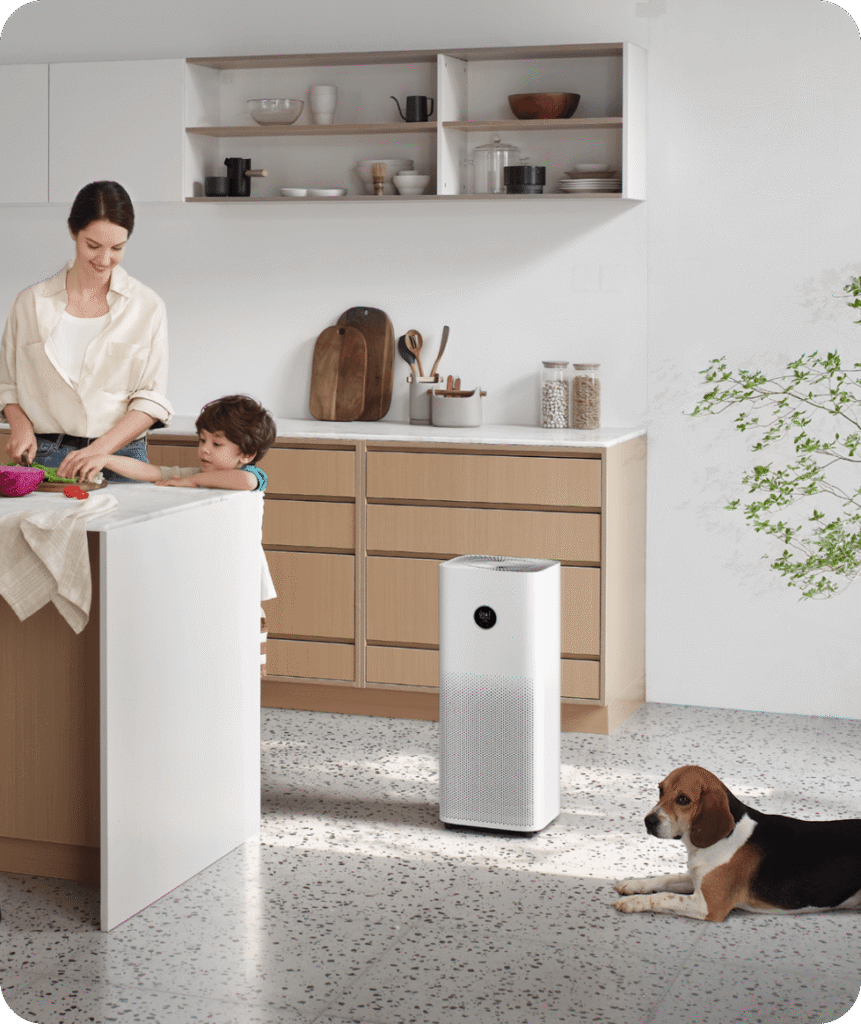
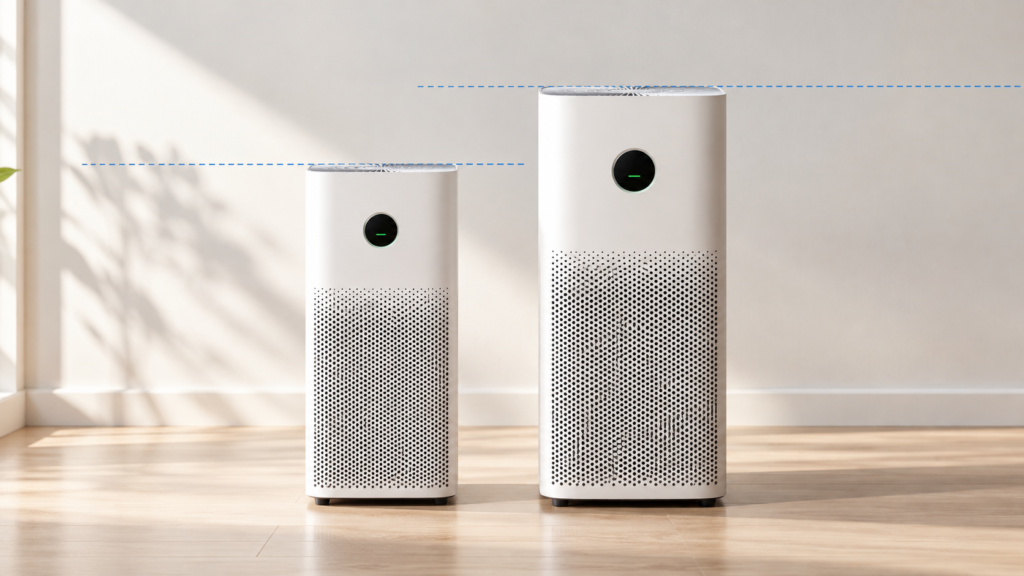
For the living room, I’m looking at the Xiaomi Air Purifier 4 Pro. It has a CADR of 500 m³/h, is rated for about 35 to 60 m², and runs at 33.7 dB in night mode.
Is it enough for an HDB living room? Based on the table above, a 35 m² living and dining area gets about 5.5 air changes an hour from the Xiaomi Air Purifier 4 Pro, a little above the 4 to 5 ACH sweet spot, so it has room to spare.
The one catch is the filter. At about S$25 on Taobao (S$75.90 from Xiaomi’s official store), it misses my own under-S$20 rule. I’m willing to let that one slide for a bigger filter in a bigger room, but it’s worth knowing before you buy.
It’s going for S$380 on Lazada and S$347 on Shopee at the time of writing.
Where to buy: 🏬 Shopee · Lazada
Bedrooms: Xiaomi Air Purifier 4 or 6?
For a standard HDB bedroom, both the Xiaomi Air Purifier 4 and the Air Purifier 6 are more than enough. With the Air Purifier 4, a 12 m² common bedroom gets nearly 13 air changes an hour on paper, and even a 16 m² master bedroom gets almost 10. The Air Purifier 6 does slightly better on both. That headroom means either one can run on a quieter setting overnight and still keep the air clean, which is exactly what you want in a room where a baby sleeps.
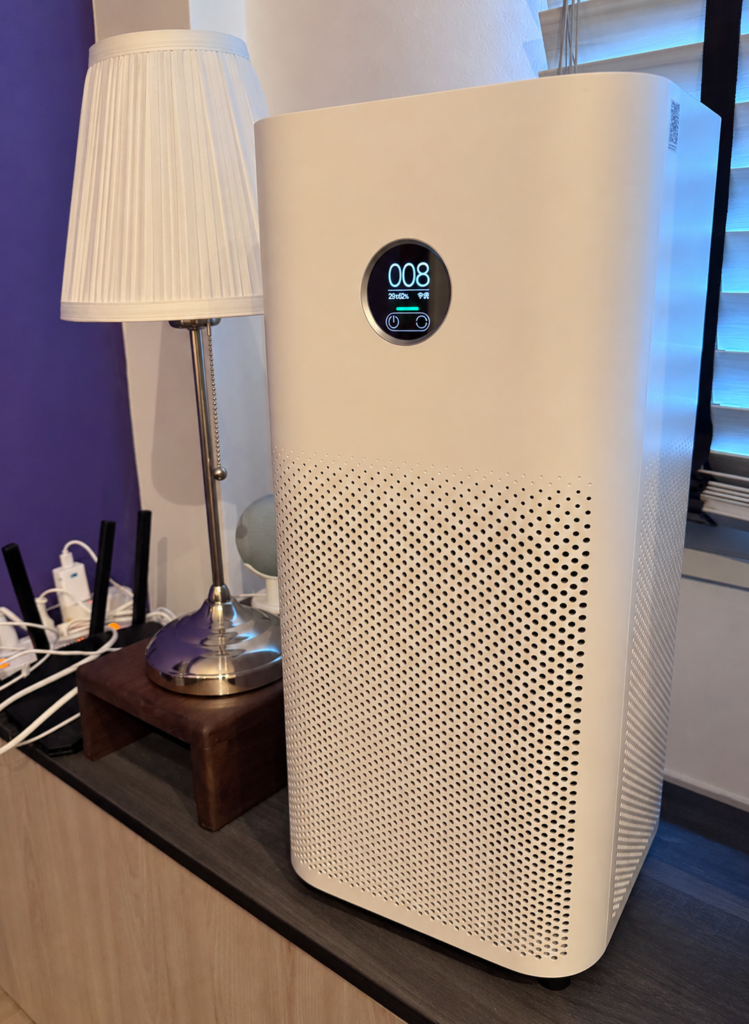
I personally use the Air Purifier 4, so that’s the one I can vouch for first-hand. But it’s out of stock in Singapore right now. The Air Purifier 6 is the newer release (Xiaomi listed it globally in August 2025), so it’s the easier one to find, and it goes for S$244 on Lazada and S$228 on Shopee currently. Honestly, either one is a good pick. Here’s how the two compare:
| Xiaomi Air Purifier 4 | Xiaomi Air Purifier 6 | |
|---|---|---|
| CADR | 400 m³/h | 443 m³/h |
| Room size | Up to 48 m² | 29 to 50 m² |
| ACH in a 16 m² master bedroom | About 9.6 | About 10.6 |
| Noise | 32.1 dB (Sleep) to 63 dB (max) | Under 32 dB (Sleep) to 64 dB (max) |
| Filter | Pre-filter, high-efficiency filter and activated carbon | Same filter as the Air Purifier 4 |
| Sensors | Laser PM2.5 | Laser PM1, PM2.5 and PM10, plus temperature and humidity |
| Display | OLED touchscreen: normal, dim and off | LCD touchscreen, adjustable brightness (off ❓) |
| Ioniser | Yes, can be switched off in the app | Yes, can be switched off in the app. Also adds UV, which can be switched off too |
| App | Mi Home, Google Assistant, Alexa | Mi Home, Google Assistant, Alexa |
| Price | Out of stock | S$228 to S$244 🏬 Shopee · Lazada |
The best part: they use the same filter. Xiaomi’s own listing for the Air Purifier 6 filter says it’s compatible with just two models, the Air Purifier 6 and the Air Purifier 4, and rates it at 99.98% for 0.3-micron particles. So one Taobao seller covers both, and if you end up with one of each, a single stash of filters covers them.
Where to buy: 🏬 Shopee · Lazada
The Verdict
At the end of the day, everyone’s requirements for an air purifier are different. My ratings are built around a newborn in a dark bedroom and a dad who can’t stop tinkering with Home Assistant. What suits me might not suit you. You might not care about smart features at all, or you might be happy to pay more for official filters in exchange for peace of mind.
But if there’s one thing that matters more than anything else, it’s this: buy for the size of your room. Not the brand, not the app, not the fancy display. An air purifier that’s too small for the space will run flat out all day and still struggle to keep up, no matter how good its filter is. Work out your room size, check the CADR against it (the sizing table above does the maths for you), and only then start comparing everything else.
Once you’ve got the size right, look for a True HEPA filter (ideally with activated carbon), a sensor-driven Auto mode, and filters you can afford to replace. Everything else is a bonus.
For our home, that’s the Daikin and the Xiaomi Air Purifier 4 in the bedrooms, the Europace in the kitchen, and next, the Xiaomi Air Purifier 4 Pro for the living room.
Since room size matters this much, that’s where I’m going next. In my next post, I’ll look at the best air purifiers for different rooms and sizes, from a small HDB common bedroom all the way up to an open-concept living and dining area.
Stay safe, keep an eye on the PSI, and more from the newborn series soon.